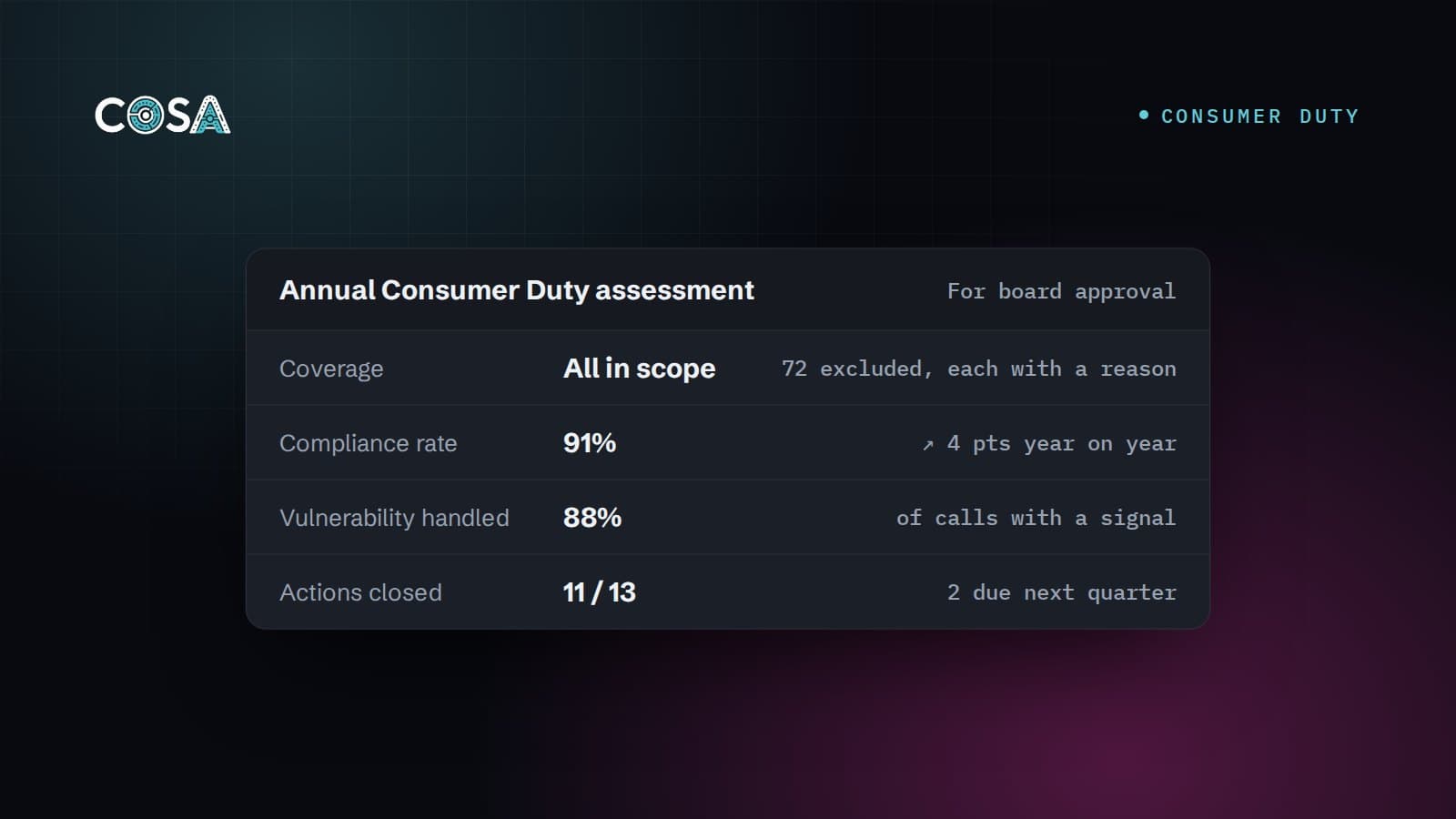
Once a year, every firm within the Consumer Duty's scope has to put a question to its board: are we delivering good outcomes for our customers — and how do we know? The quality of the answer depends almost entirely on the evidence behind it. For advice firms, much of that evidence is in client conversations.
What the rules require
Under PRIN 2A, a firm's governing body must review and approve an assessment of whether the firm is delivering good outcomes for its customers, consistent with the Duty, at least once a year. The assessment should set out the evidence, any action the firm has taken or needs to take, and how future business plans are consistent with the Duty. The FCA also expected firms to appoint a board-level champion for the Duty.
The FCA has since published examples of good practice and areas for improvement from firms' board reports. Recurring themes are easy to recognise: reports that describe processes rather than outcomes, MI that isn't analysed or doesn't support the conclusions drawn, too little on how different groups of customers fare, and actions without clear owners.
A practical structure
- Conclusion first. One paragraph: are customers receiving good outcomes, where aren't they, and what will change?
- Scope and evidence sources. What was monitored and how — including which calls were assessed and which were excluded, and why.
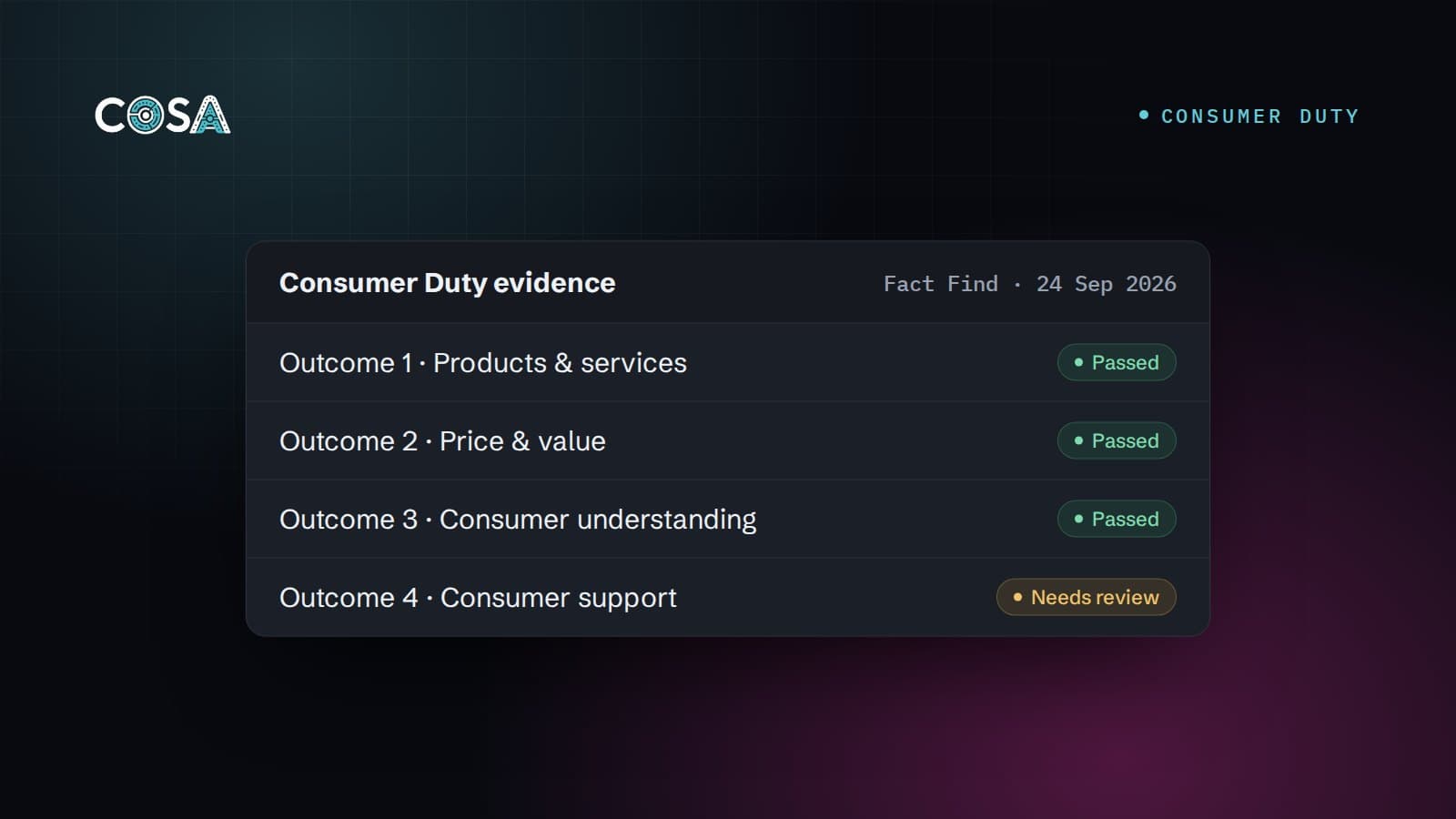
- Outcome by outcome. Products and services, price and value, consumer understanding, consumer support — each with measures, trends and findings.
- Customer groups. How outcomes differ between groups, with customers who have characteristics of vulnerability as a group of their own.
- Root causes and actions. What went wrong, why, who owns the fix and by when.
- Progress since last year. Whether last year's actions worked, with evidence.
- Board challenge and approval. The questions the board asked, and its decision.
Call-derived MI for each section
| Section | Call-derived evidence | An example finding |
|---|---|---|
| Scope | In-scope calls assessed; exclusions by reason | "Every fact find and follow-up over two minutes was assessed; 6% of calls were excluded, mostly voicemails." |
| Products & services | Objectives captured; alternatives discussed | "Alternatives were discussed on 93% of fact finds, up from 81% after script changes in Q2." |
| Price & value | Costs, charges and long-term effects explained | "Early repayment charges were the most-missed rule on follow-up calls." |
| Consumer understanding | Key risks covered; understanding checked | "Understanding checks were weakest on calls over 45 minutes." |
| Consumer support | Vulnerability signals, handling and follow-up | "Bereavement was the most common signal; handling improved after targeted coaching." |
| Actions | Most-missed rules, adviser trends, overrides | "Two rules were reworded after frequent reviewer overrides showed they were too strict." |
The example findings are illustrative, to show the kind of statement good MI supports.
Presenting it so the board can challenge it
- Trends over snapshots. Twelve months of data shows whether things are improving; a single quarter doesn't.
- Definitions up front. What "compliance rate" means, how calls are scoped, and any rule changes during the year.
- Method and limits. How results were produced and checked, including human review of flagged calls and the rate of overrides.
- Evidence on request. Be ready to show the underlying calls, verdicts and quotes behind any headline figure — to the board or to the FCA.
Make the annual report a summary, not a scramble
The firms with the strongest board reports don't assemble them in the last month. They build monthly or quarterly MI around the four outcomes with stable definitions, and the annual assessment summarises it. Our guide to compliance MI your board will read covers the dashboard side.
COSA produces this kind of MI from every assessed call — compliance rate by call type and adviser, the most-missed rules, vulnerability flags and coverage with exclusions logged — and exports the evidence behind it. See how it supports the Consumer Duty.
This article is general information, not legal or regulatory advice. Refer to PRIN 2A and FG22/5 for the requirements that apply to your firm.