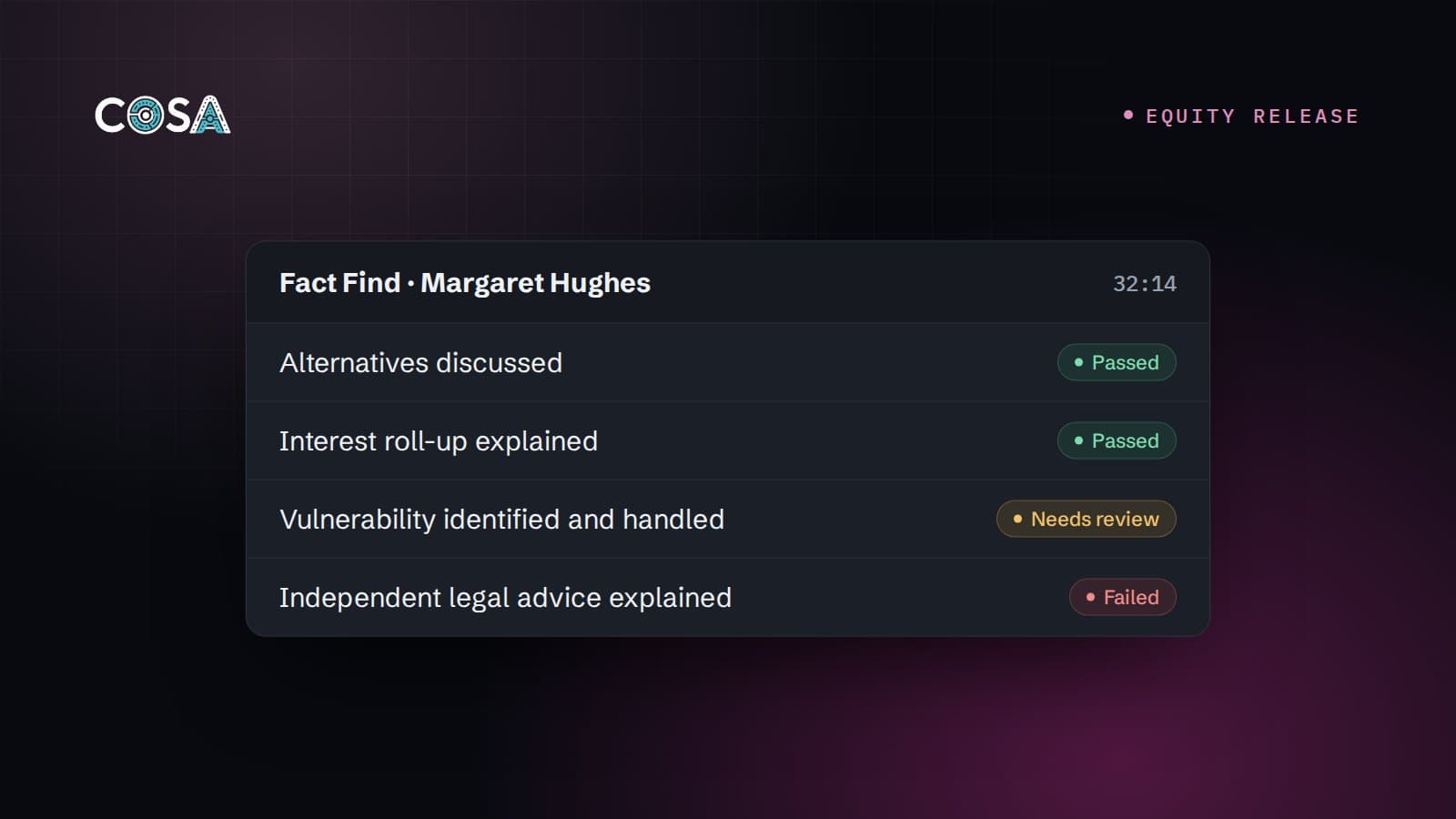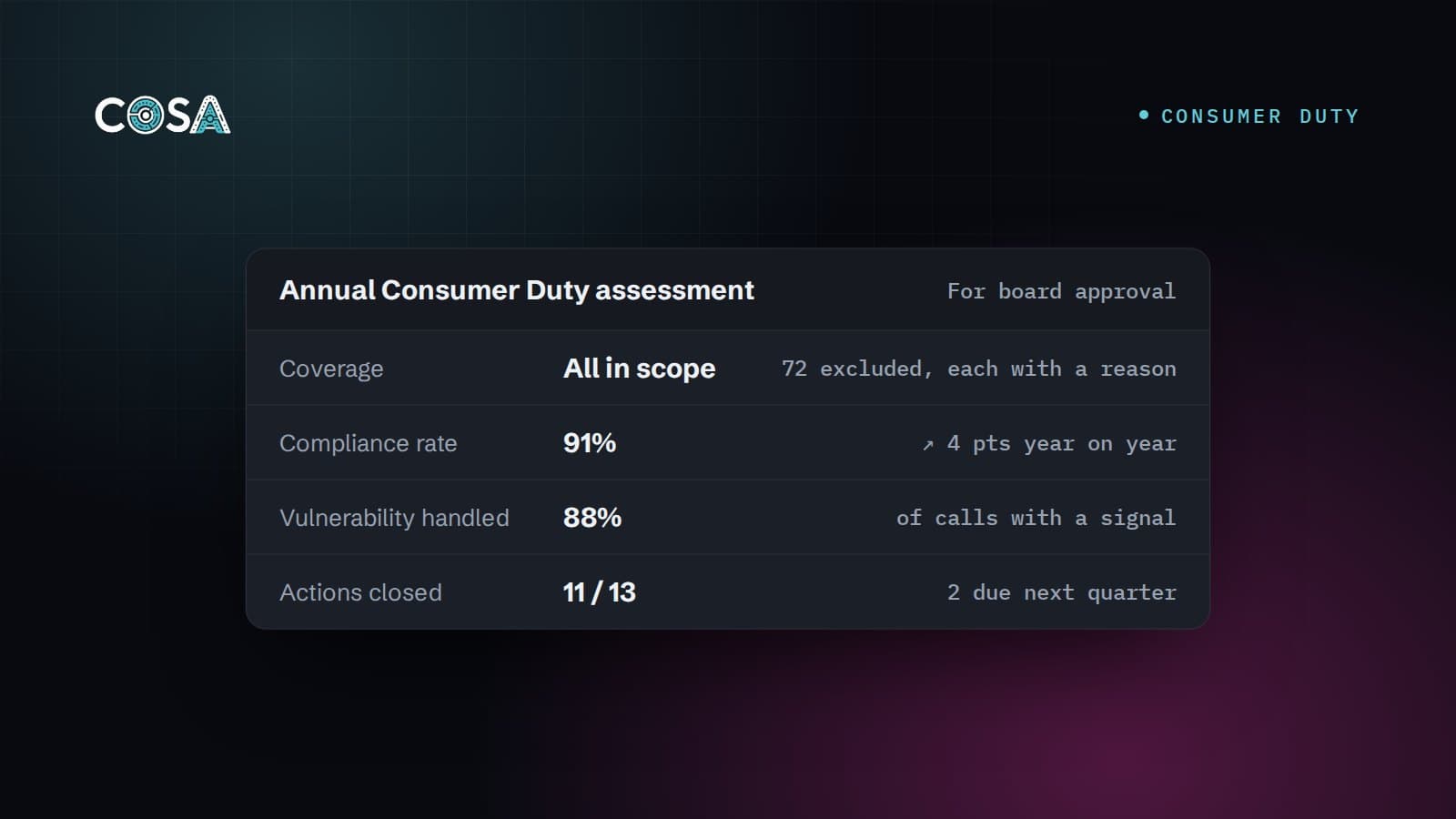
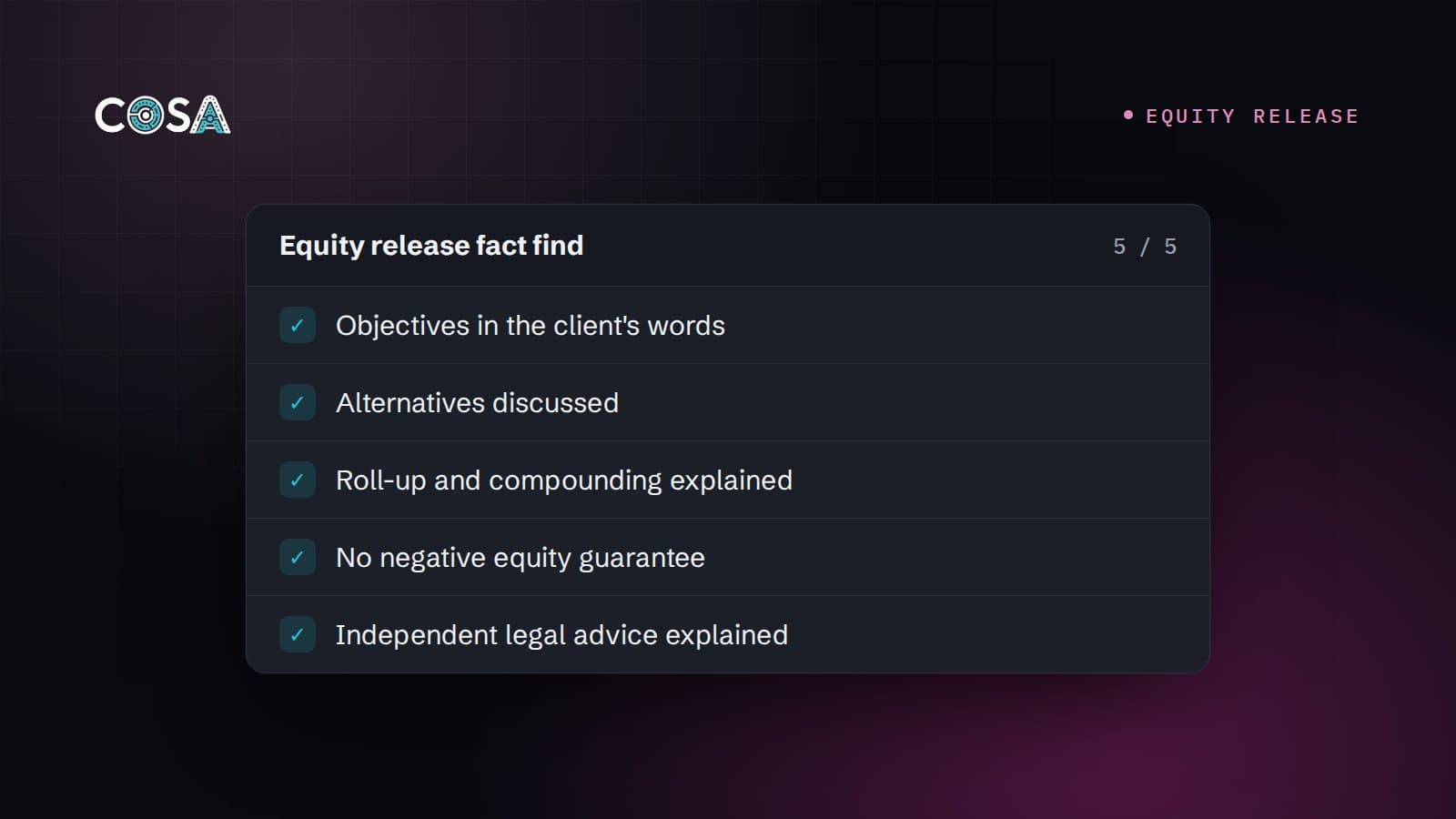
An equity release fact find covers a lot of ground, and most of it matters. This checklist sets out what compliance should expect to hear, in roughly the order a good call covers it — with why each point matters and the kind of rule that checks it. Adapt it to your own policies and the standards your firm follows.
1. Setting up the call
- Recording notice. Customers should know the call is recorded. Most firms script the wording, which makes it a natural verbatim rule.
- Who's on the call. If someone else is present or speaking, who they are, whether the customer is happy for them to be there, and whether they hold any authority, such as a power of attorney.
- Purpose in the customer's words. "It's mainly for the roof, and to help the grandchildren" is evidence. "Customer wishes to release equity" is not.
2. Needs, objectives and alternatives
Equity release should be the right answer, not the default one. The call should show alternatives were explored and, where discounted, why:
- downsizing or moving;
- using savings or other assets;
- other borrowing, such as a retirement interest-only or standard mortgage;
- grants, local authority help or unclaimed benefits;
- help from family.
Because released money can affect entitlement to means-tested benefits, the call should show the adviser considered this for the customer's circumstances.
3. How the product works
The customer should come away understanding the mechanics, not just the headline figure:
- Interest roll-up and compounding. Interest is usually added to the loan rather than paid, so the balance grows. As an illustration, at 6% a year a balance roughly doubles in 12 years — £45,000 would become about £90,000.
- Lump sum or drawdown, and how drawing only what's needed can reduce interest.
- Voluntary repayments — whether the customer can make them, and within what limits.
- Early repayment charges, and the circumstances in which they apply.
4. The product's protections
Plans that meet the Equity Release Council's standards include protections the customer should hear explained, including:
- the right to remain in the property for life, or until moving into long-term care, provided the terms are kept;
- the right to move to another property, subject to the lender's criteria;
- the no negative equity guarantee — the customer will never owe more than the value of their home;
- interest that is fixed, or capped for life if variable;
- the right to make penalty-free voluntary partial repayments, subject to lending criteria.
5. Costs and the estate
- Fees: advice, arrangement, valuation and legal costs, and when each is paid.
- The effect on inheritance, in concrete terms, and whether inheritance protection is relevant.
- Family involvement encouraged where the customer agrees — and handled carefully if someone else seems to be steering the decision.
6. Health, vulnerability and understanding
- Health and lifestyle questions for enhanced terms, asked sensitively. Answers aren't signs of vulnerability on their own.
- Vulnerability. Listen across all four drivers — health, life events, resilience and capability — and for how the adviser adapted. (More in identifying vulnerable customers on calls.)
- Understanding checked. "Could you tell me in your own words what happens to the balance?" is stronger evidence than "Does that make sense?"
7. Independent legal advice and next steps
- Independent legal advice explained: what the solicitor does, and that it is part of the process.
- Documents: that the illustration (KFI) will follow, and that figures discussed on the call match it.
- Next steps, with who does what and when — including anything the customer has agreed to send or discuss with family.
The checklist at a glance
| # | What to hear | Why it matters | Rule type |
|---|---|---|---|
| 1 | Recording notice | Transparency: the customer knows they are being recorded | Verbatim |
| 2 | Objectives in the customer's words | Anchors suitability (products & services) | Non-verbatim |
| 3 | Alternatives discussed, reasons recorded | Equity release shouldn't be the default | Non-verbatim |
| 4 | Effect on means-tested benefits | Released money can reduce entitlement | Non-verbatim |
| 5 | Interest roll-up and compounding explained | The core cost of the product (price & value) | Non-verbatim |
| 6 | Voluntary repayments and early repayment charges | Flexibility and exit costs | Non-verbatim |
| 7 | Protections explained, including the no negative equity guarantee | Consumer understanding | Non-verbatim |
| 8 | Effect on the estate; family involvement offered | The decision affects others | Non-verbatim / objection handling |
| 9 | Vulnerability identified and handled | Consumer support; FG21/1 | Vulnerability |
| 10 | Understanding checked in the customer's words | Consumer understanding | Non-verbatim |
| 11 | Independent legal advice explained | Required for plans meeting ERC standards | Non-verbatim |
| 12 | Figures consistent with the illustration | What was said should match what was sent | Document check |
| 13 | Clear next steps and owners | Consumer support; no loose ends | Non-verbatim |
Checking every call, not a sample
A checklist is only as useful as the number of calls it's applied to. With COSA, each point becomes a rule — scoped to the call types it applies to — and every in-scope call is assessed against it, with the quote and reasoning behind each verdict. Reviewers see which calls need attention, and a client's whole history exports as one pack when it's needed. Explore the platform or see how Compare Retirement uses it.
This checklist is general information, not legal or regulatory advice, and isn't a substitute for your firm's own policies, MCOB or the Equity Release Council's rules and standards. Equity release may reduce the value of an estate and can affect entitlement to means-tested benefits.