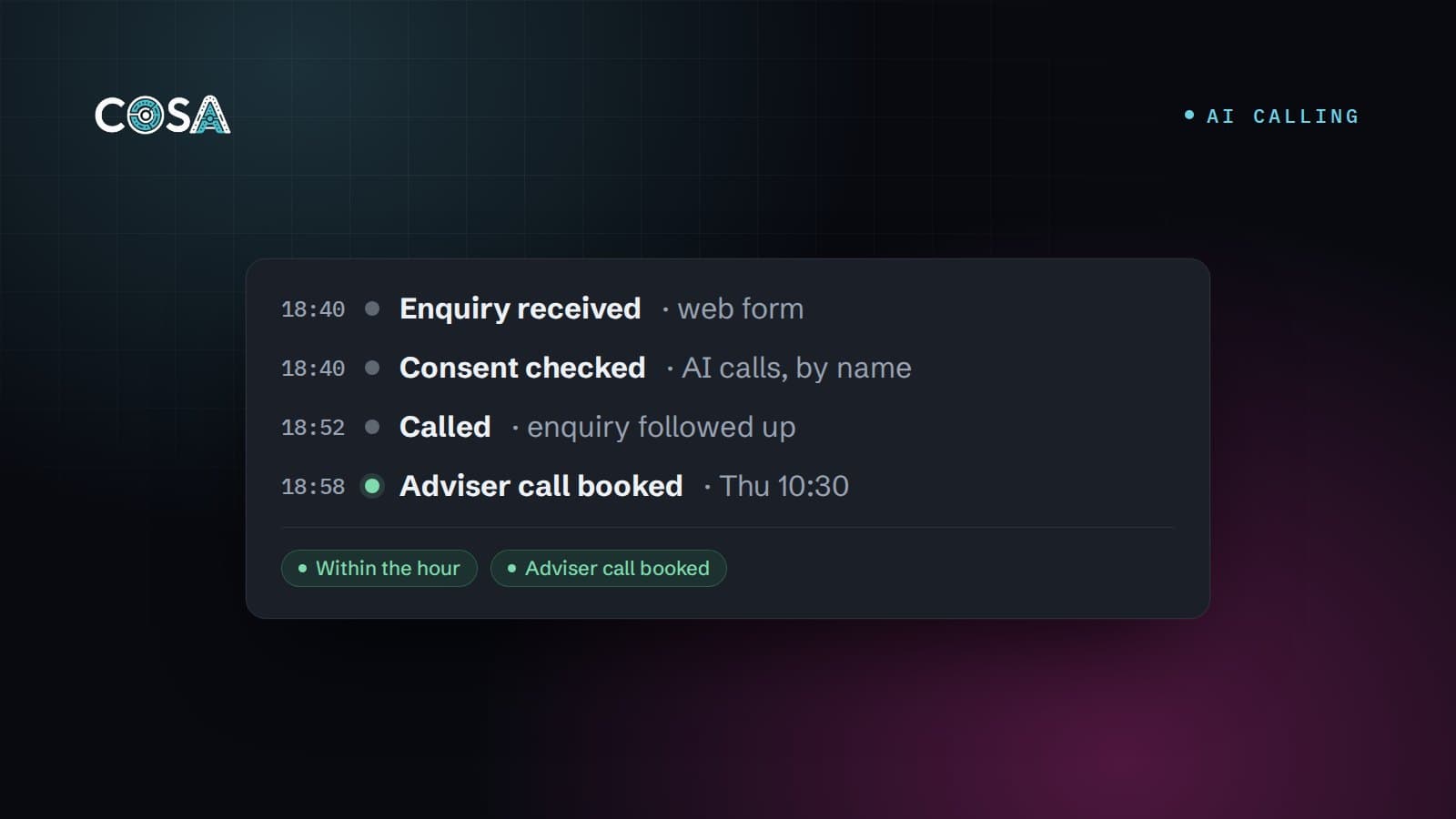
Someone who asks about equity release is usually older, often cautious, and asking about the home they have lived in for decades. An AI caller can follow up that enquiry promptly, answer the first questions and book the adviser, but only if it knows exactly where its job ends. Here is what it should say, what it must never say, and how to hand over.
Why enquiry follow-up matters in later-life lending
Demand is there. The Equity Release Council's figures for the second quarter of 2026 show £597m of lending, up 4% on the first quarter, across 13,489 new and returning customers. New customers rose 9% to 5,307. Lending was still below the same quarter of 2025, but more than a third (37%) of firms in the Council's adviser survey expected enquiries to increase in the third quarter.
Capacity is the harder problem. Speaking at Air's Evolve Summit in October 2026, Air chief executive Will Hale warned that later-life advisers who fail to embrace AI risk missing out on sector growth, pointing to Air's data that fewer than 2,000 advisers had placed more than one equity release case in the previous 12 months (reported by The Intermediary). His argument was about freeing advisers from work that doesn't need them, not replacing them.
Enquiry follow-up is a clear example of that work. An enquiry that waits days for a call back often goes cold (see speed to lead in financial advice). But speed is not the only test: this is a first conversation with an older homeowner about a lifelong product secured on their home, and what is said matters as much as how quickly.
Where an AI caller fits, and where it must stop
Equity release advice is regulated. Under MCOB 8.5A, a firm advising on an equity release transaction must take reasonable steps to make sure it is suitable, which means appropriate to the customer's needs and circumstances, based on the facts they disclose and other relevant facts the firm knows or should know. That is a judgement for a qualified adviser, and an AI caller should never attempt it. A sensible division of labour:
| The AI caller can | The adviser keeps |
|---|---|
| Follow up an enquiry the person made, and say so | Whether equity release is suitable at all |
| Confirm contact details and the best time to talk | The alternatives, such as downsizing, savings, other borrowing or family help |
| Check a few basic details: the owners' ages, a rough home value, any existing mortgage, what the money is for in their words | What the customer personally could borrow, and on what terms |
| Answer general questions from facts the firm has approved | Which plan or lender, if any |
| Book a call with the adviser, or note when they would like one | The effect on the customer's own tax, benefits and estate |
What it can say: general facts the firm approves
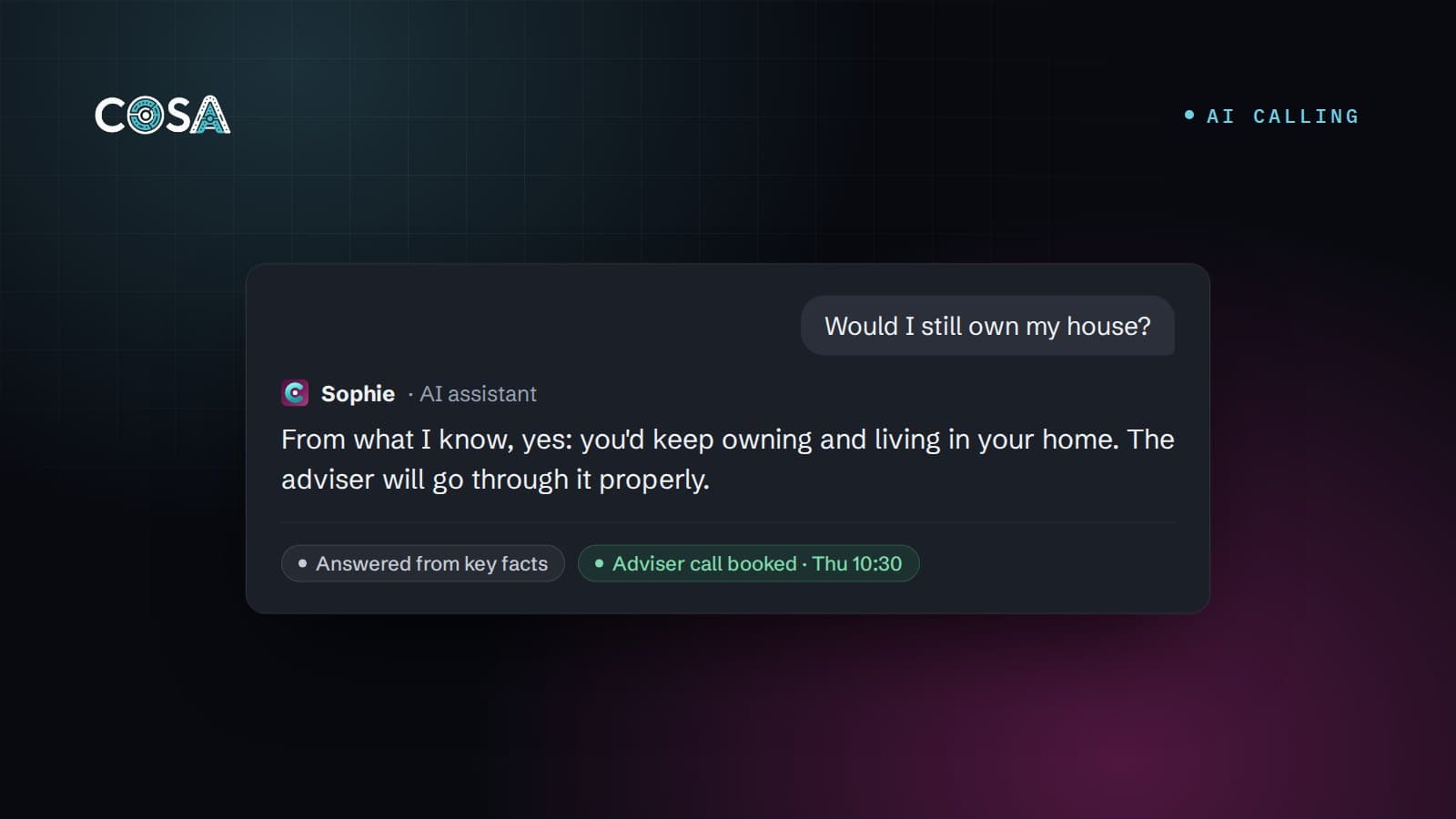
Most early questions are general ones: "Would I still own my house?", "Do I have to make payments?", "Could I end up owing more than it's worth?" An AI caller can answer these, provided every answer comes from wording the firm has approved and the answer is phrased generally rather than about the person's own case. A typical set of key facts for a lifetime mortgage enquiry might include:
- Age. Lifetime mortgages are usually available from age 55, and every named owner normally needs to meet the minimum age.
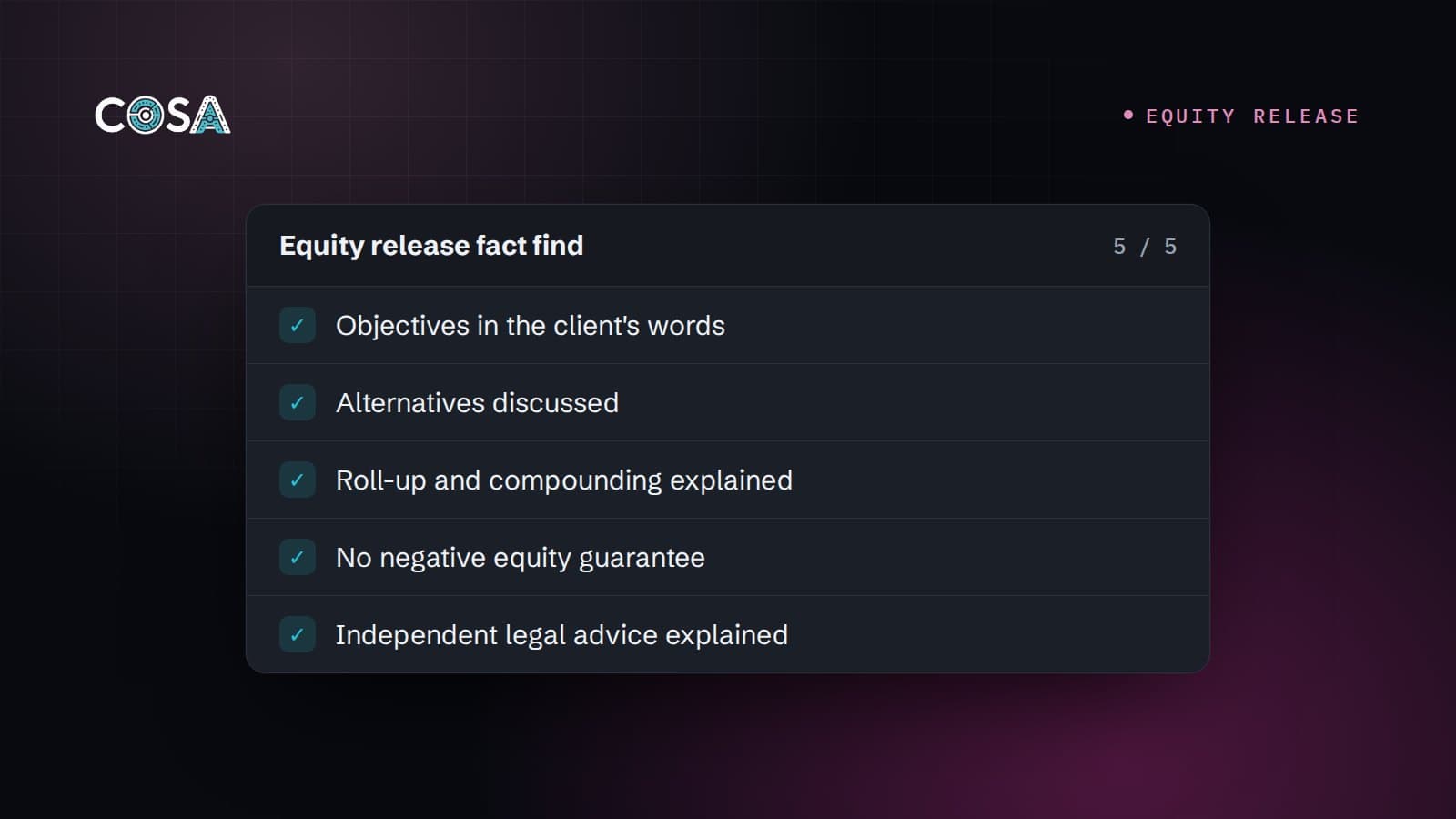
- Ownership. With a lifetime mortgage, you keep owning your home and carry on living in it.
- Payments. There are usually no monthly payments unless you choose to make them, and many plans allow voluntary repayments within limits.
- Interest. Where interest isn't paid, it is usually added to the loan and compounds, so the amount owed grows over time (see interest roll-up).
- Protection. Plans that meet the Equity Release Council's standards include a no negative equity guarantee: provided the home is sold for the best price reasonably obtainable and the terms of the loan have been kept, you, or your estate, will never owe more than the property is worth.
- Tax and benefits. Money released is tax-free, but it can affect entitlement to means-tested benefits. The adviser will look at this for your situation.
- Existing mortgage. Any existing mortgage normally has to be repaid from the money released.
- How much. The amount available depends mainly on the age of the youngest owner and the value of the home.
- Legal advice. Plans that meet the Council's standards require independent legal advice from your own solicitor before the plan goes ahead.
The hedges ("usually", "many plans", "plans that meet the Council's standards") do real work: they keep a general statement true across lenders and stop it sounding like a promise about the customer's own plan. And the Council is a trade body, not the regulator, so nothing should imply regulatory approval.
Figures: a rough range at most
"How much could I get?" is the commonest question, and the safe default is that the adviser answers it. If a firm lets its caller give an indication:
- figures come only from the firm's own approved sheet of age bands and rates, dated, with an expiry;
- they are given as a rough range, rounded down, and described plainly as "not a quote";
- compliance has signed off the bands, the rates and the spoken wording, and any change needs signing off again;
- nothing is said before any identity check the firm requires;
- the caller explains that the adviser will work out what is actually available.
What it must never say
- Eligibility or approval. "You qualify", "you'd be accepted". The caller doesn't know, and the adviser may have to undo the expectation.
- Suitability. "This sounds right for you", "equity release is the best option for the roof". That is advice.
- Pressure, urgency or scarcity. "Rates are about to go up", "limited availability this week". There is no place for it on a call about someone's home.
- Any rate, amount, lender or product it wasn't given. If it isn't in the approved facts or the signed-off sheet, the answer is "the adviser will go through that with you".
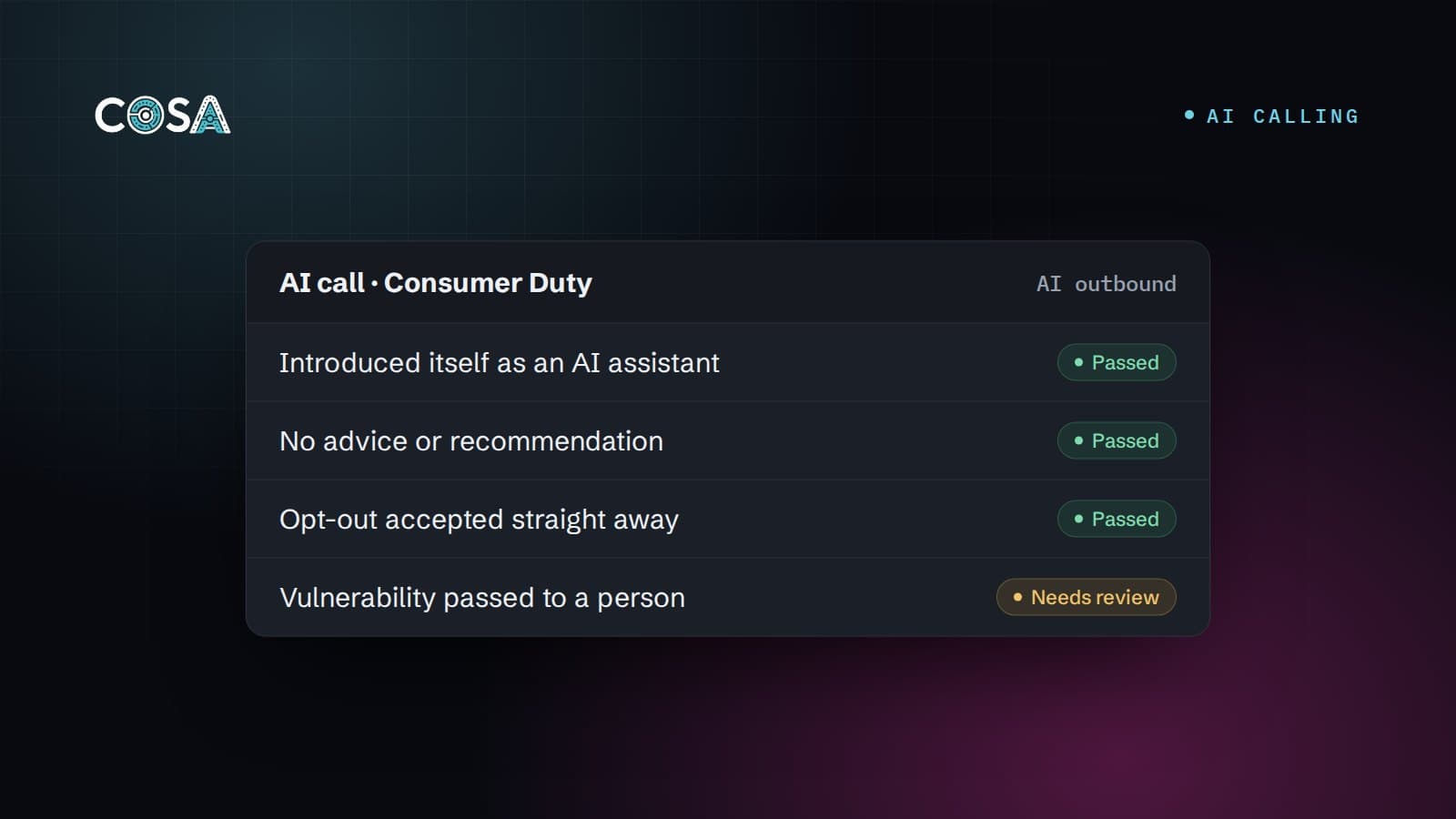
- Pretending to be a person or an adviser. If asked, it says honestly that it is an AI assistant and offers to arrange for a person to call.
And when someone says they aren't interested or don't want any more calls, the caller accepts that straight away, says so, and the firm stops contacting them.
Handling common concerns
None of these is an objection to overcome. Each deserves a straight answer and an easy way forward, including no.
"I'm just looking"
That is a reasonable place to be. Good wording: "That's absolutely fine. A lot of people like to understand how it works before deciding anything. The adviser call is a chance to ask questions, with no obligation. Would that be useful, or would you rather leave it for now?"
"Is this a sales call?"
Be honest about why the call is happening. Good wording: "I'm calling because you asked about equity release on our website. I can answer a few general questions and, if you'd like, book a call with one of our qualified advisers. I can't give advice myself, and there's no obligation."
"I want to talk to my family first"
Welcome it. The decision can affect what the family inherits, and involving them is often encouraged. Good wording: "That's very sensible. If it helps, they'd be welcome on the call with the adviser. Shall I find a time that would suit them too?"
"Is this a scam?"
Treat the question as sensible, because it is. Good wording: "It's right to be careful. You're welcome to put the phone down and ring us back on the number on our website, and we'll pick up from there. We'll never ask you for bank details or passwords on a call like this." The caller should never argue, and never ask for financial details to "prove" anything.
"I already have an adviser"
Respect it. Good wording: "That's fine, thank you for letting me know. Would you like us to close your enquiry, or would you still like a second conversation?" Then do what they ask.
Vulnerability and older customers
The FCA's guidance on the fair treatment of vulnerable customers (FG21/1) describes a vulnerable customer as someone who, because of their personal circumstances, is especially susceptible to harm, particularly when a firm is not acting with appropriate levels of care. Age alone doesn't make someone vulnerable, but the stakes in equity release are high. For an AI caller, that means:
- Speak clearly and unhurriedly. Short sentences, one question at a time.
- Let them finish. Pauses are normal; a caller that cuts in is a poor fit for this market.
- Never assume a spouse. Use the person's own words for the people in their life. "Your husband" is wrong for a widow or a single owner.
- Notice the signs and hand over. Confusion, distress, a recent bereavement, someone else steering the answers: the caller should stop gathering details or discussing figures, offer to pass the conversation to a person, and flag it for follow-up.
The Equity Release Council launched Safe Steps, a vulnerability guidance hub for the later-life lending sector, in November 2025, which is a useful reference when writing these rules. For signals to listen for, see identifying vulnerable customers on calls.
The booking handover
The booking should go straight into the adviser's own diary at a time the customer chose; if nothing suits, the caller notes when they would like a call. Where a firm enables a warm transfer, the adviser should be briefed before the customer is connected, with a fall-back to booking if no one picks up. Before the call, the adviser should receive:
- a short summary of the conversation;
- the details captured, in the customer's own words where it matters ("mainly the roof, and something for the grandchildren");
- the concerns raised, such as wanting family present, and any signs of vulnerability;
- the recording and transcript.
A person should check captured details before they are relied on in the fact find.
Consent and calling rules, in brief
Only call people who asked to hear about equity release. The ICO says consent for automated marketing calls must specifically cover automated calls; general marketing consent, or consent to live calls, is not enough. The cautious position is to treat AI calls as automated calls and get specific, prior consent that names the firm. Is AI calling legal in the UK? covers consent, calling hours and caller ID in detail. For how an AI caller fits the FCA's outcomes framework, see AI voice agents and the Consumer Duty.
A worked example
This conversation is illustrative. Names and details are made up.
AI caller: Hello, is that Mrs Patel? This is James, an AI assistant from [firm], calling about the equity release enquiry you made on our website on Tuesday. This call is recorded, and you can ask me to stop calling, or to speak to a person, at any time. Is now an all right time?
Customer: Oh, yes, I suppose so. I was only looking, really.
AI caller: That's absolutely fine. I can answer a few general questions and, if it helps, book a call with one of our advisers. I can't give advice myself. What made you start looking?
Customer: The roof needs doing. But would I still own my house?
AI caller: With a lifetime mortgage, you keep owning your home and carry on living in it. Interest is usually added to the loan, so the amount owed grows over time, and the adviser would go through exactly how that works for you.
Customer: I'd want my son to hear all this.
AI caller: That's very sensible. He'd be welcome on the call with the adviser. Would a weekday morning suit you both?
Customer: Thursday morning, he's off then.
AI caller: I've booked Thursday at half past ten with Sarah, one of our advisers. She'll have a note that your son is joining and that the roof is the main reason.
No figure, no "you'd qualify", no urgency, and the son was welcomed rather than worked around.
Say / don't say
| Say | Don't say |
|---|---|
| "I'm an AI assistant. I can't give advice, but I can book you a call with an adviser." | Anything implying the caller is a person or an adviser |
| "Plans that meet the Equity Release Council's standards include a no negative equity guarantee." | "You can't lose your house," or "it's FCA approved" |
| "The adviser will work out what's actually available to you." | "You qualify," "you'd be accepted," or a figure that wasn't approved |
| "This is a rough range from our approved figures, not a quote." | A single precise amount, or a rate it wasn't given |
| "Your family would be welcome on the call." | "You don't need to involve your family." |
| "You're welcome to ring us back on the number on our website." | Pushing back when someone asks if it's a scam, or asking for bank details |
| "There's no obligation, and no rush." | "Rates are about to rise," "limited slots," or any other urgency |
| "Of course. I'll make sure we don't call again." | Another attempt after someone says no |
The COSA AI Dialler's equity release template
The COSA AI Dialler includes an equity release template, designed in house and shaped by real equity release booking calls. It follows up enquiries, checks a few details and books the adviser call into their Microsoft 365 or Google calendar. It ships with key facts like those above and handles the common concerns, including "is this a scam?". It never advises, never says someone qualifies, and never gives a rate, amount or provider outside the firm's approved facts, answers or estimate. Rough release estimates are optional and can't be published until the firm's compliance lead approves the bands, rates and wording. Signs of vulnerability lead it to stop gathering details and offer a person. Warm transfer is off by default, and each call is filed on the client's record in COSA. More on COSA for equity release firms.
This article is general information, not legal or regulatory advice, and isn't a substitute for your firm's own policies, MCOB, the ICO's guidance or the Equity Release Council's rules and standards. Equity release may reduce the value of an estate and can affect entitlement to means-tested benefits.