Speed to lead is the time between someone making an enquiry and your firm first contacting them. It is one of the most quoted ideas in sales, usually with a dramatic statistic attached. The research behind those statistics is real, but it is American, more than a decade old and often misquoted. Here is what it actually found, and what it means for a regulated UK advice firm.
What is speed to lead?
Speed to lead, or lead response time, is how long it takes a firm to make its first attempt to contact someone after they enquire: by filling in a web form, requesting a callback or asking for a guide. For an advice firm it is usually the gap between a form arriving and the first phone call.
The reasoning is simple. When someone enquires, they are thinking about the subject right then. Hours or days later they may have moved on, spoken to another firm, or simply be harder to reach. The question is how much the delay matters, and that is where the research comes in.
How fast should you call a web lead?
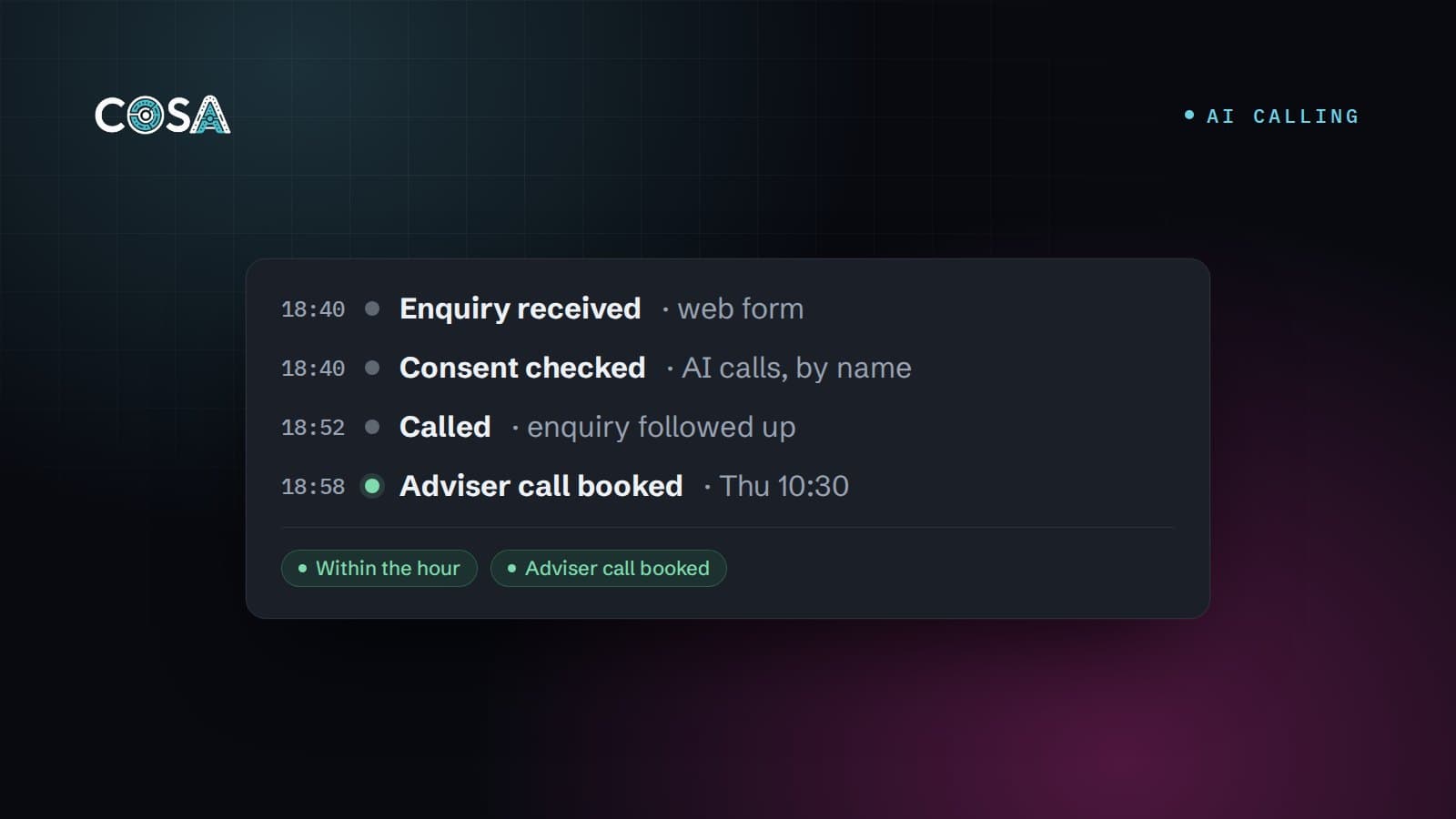
The short answer is as fast as you reasonably can, ideally within the hour. That is what the strongest published evidence points to. Two caveats come with it: the evidence is about contacting and qualifying leads, not about advice outcomes, and it shows an association rather than proving that speed alone causes the difference. Within those limits, an hour is a sensible target, the same day is a minimum, and "when we get round to it" loses enquiries.
The Harvard Business Review study (2011)
In March 2011, Harvard Business Review published "The Short Life of Online Sales Leads" by James Oldroyd, Kristina McElheran and David Elkington. It reported two different pieces of research, and the figures from one should never be attached to the other.
1. The audit: how quickly did companies respond?
The authors audited 2,241 US companies, sending each a web enquiry and timing the response. They found that:
- 37% responded within an hour;
- 16% responded within one to 24 hours;
- 24% took more than 24 hours; and
- 23% never responded at all.
Among companies that responded within 30 days, the average response time was 42 hours. That average leaves out the companies that never replied, so it flatters the overall picture.
2. The lead analysis: did speed make a difference?
Separately, the authors analysed 1.25 million sales leads received by US companies. Firms that tried to contact a potential customer within an hour of receiving an enquiry were nearly seven times as likely to qualify the lead, which the authors defined as having a meaningful conversation with a key decision maker, as firms that tried to make contact even an hour later. They were more than 60 times as likely to qualify it as firms that waited 24 hours or longer.
This is the finding behind most "call within the hour" advice. It is worth reading carefully: "qualify" here means reaching the right person for a meaningful conversation, not making a sale, and certainly not giving suitable advice.
The 2007 Lead Response Management study
The other statistic you will see everywhere is that calling within five minutes makes you 100 times more likely to reach a lead. It comes from the Lead Response Management study, presented in 2007 by the sales software company InsideSales.com with James Oldroyd, then a researcher at MIT. The study's headline findings were that the odds of contacting a lead were 100 times higher, and of qualifying it 21 times higher, when the first call was made within five minutes rather than 30.
It needs more care than the HBR work:
- It was vendor-linked. InsideSales.com sold lead response software, and the study was presented as industry research, not published in a peer-reviewed journal.
- The sample was small. Its own summary describes three years of data from six companies: over 15,000 leads and over 100,000 call attempts. Six companies cannot represent a whole market, let alone a different country and sector.
- It is often misattributed. The figures are regularly credited to "MIT" or to Harvard Business Review. Neither published the 2007 study.
- It did not measure sales. The study looked at contact and qualification, not whether anyone went on to buy.
The direction of the finding is consistent with the HBR analysis. The size of the multipliers is not something a UK firm should plan around.
Why the research needs care: it is American and old
Both studies are about US companies, mostly selling to businesses or to consumers in unregulated markets, using data from before 2011. Since then, how people enquire has changed: more enquiries arrive on mobiles, in the evening and through comparison sites, and many people now expect a text or email alongside a call.
There is also a question of cause and effect. Firms that respond within the hour may simply be better run, better staffed or better at choosing which enquiries to buy. The HBR analysis shows that fast responders qualified far more leads; it cannot prove that speed alone explains all of the gap.
None of this means speed does not matter. It means the dramatic multipliers are illustrations, not forecasts. The useful conclusion is modest and robust: respond the same day at the latest, aim for the first hour, and find out from your own data what speed is worth to you.
Why equity release and mortgage enquiries go cold
For later-life lending and mortgage firms, the common reasons an enquiry goes cold are ordinary ones:
- They asked more than one firm. The first firm to have a helpful conversation often becomes the firm they deal with.
- They enquired out of hours. A form filled in at 8pm on a Thursday may not be seen until Friday morning, by which time they are at work or out.
- The moment passed. An equity release enquiry is often the start of thinking, not a decision. Without a prompt follow-up, it can drift.
- They could not be reached. One unanswered call, with no second attempt at a better time, is not follow-up.
Most of these are fixed by a prompt, unhurried first call at a time that suits the person, ending with a booked adviser appointment rather than a promise to ring back.
What applies to regulated advice firms in the UK
A US sales study has nothing to say about PECR or the Consumer Duty. For a UK advice firm, speed sits inside some important limits.
Only call people who asked you to
Speed to lead is about responding to an enquiry, not cold calling. A call made because the person asked for it is a solicited call; the ICO's guidance on live marketing calls explains that most of the PECR rules do not apply to genuinely solicited calls. Buying a list does not make calls solicited. If the call is made by an AI or another automated system, the consent position is different and stricter; our article on whether AI calling is legal in the UK covers it.
Call at sensible times
Calling within the hour is no help if the enquiry arrived at 11pm. Set calling hours in your policy and keep to them: weekdays and, where your firm offers it, evenings and Saturdays. Avoid Sundays and bank holidays unless the person has asked for a call then. If they choose a time, call at that time.
Fast diallers have a trap of their own. A system that rings numbers faster than anyone is free to talk creates abandoned and silent calls, which Ofcom treats as persistent misuse. Speed should never come at the cost of a person answering to silence.
Speed must not become pressure
The Consumer Duty's cross-cutting rules require firms to act in good faith and avoid causing foreseeable harm. A fast first call is good service. A first call that pushes for a decision, suggests a deal will disappear or treats hesitation as an objection to overcome is not. For equity release in particular, the first call's job is to answer questions, gather a few details and book time with a qualified adviser; nobody should feel hurried into a lifetime decision.
Support existing customers as well as new ones
The consumer support outcome in PRIN 2A.6 is about support across the whole relationship. Its guidance says a firm is unlikely to comply if its support causes unreasonable delays, such as disproportionately longer call waiting times to cancel or change an existing product than to buy one. A firm that answers new enquiries in minutes but leaves existing clients waiting days has the balance wrong. See our guide to the consumer support outcome on advice calls.
Call fast, then slow down
Many people enquiring about equity release are older, and some will be vulnerable customers: recently bereaved, unwell or under financial strain. The FCA's guidance on vulnerability, FG21/1, expects firms to recognise and respond to those needs. Calling quickly is fine; rushing the conversation is not. Let people finish, offer to involve a family member, and if there are signs of vulnerability, make sure a person picks the case up.
Practical ways to respond quickly
- Route enquiries automatically. Every web form, callback request and comparison-site lead should land in one queue with a timestamp, not in someone's inbox.
- Set a response target by hour of arrival. For example: within the hour during calling hours, and first thing in the next calling window otherwise.
- Cover evenings and Saturdays within your hours. If many enquiries arrive after work, a 9-to-5 team will always be behind.
- Book, do not just call. The aim of the first call is a booked appointment in an adviser's calendar, or a callback at a time the person chooses.
- Plan more than one attempt. Try again at a different time of day, within sensible limits, and stop when someone asks you to.
- Consider AI follow-up for first contact. An AI agent can call new enquiries within your calling hours, answer factual questions and book adviser calls, leaving advisers to give advice.
How to measure your own response time
The only response-time figures that really matter are your own. Record the time each enquiry arrives and measure these intervals:
| Measure | From | To | What it tells you |
|---|---|---|---|
| Time to first attempt | Enquiry received | First call attempted | How quickly your process reacts |
| Time to first conversation | Enquiry received | First call answered by the person | Whether you are reaching people, not just dialling |
| Time to booked appointment | Enquiry received | Adviser call booked | Whether contact turns into a next step |
| Never contacted | Enquiries with no conversation after, say, 14 days | Leads lost entirely | |
Three tips make these numbers useful:
- Use the median, not the mean. A handful of enquiries left for a week will drag an average up and hide how quickly you handle the typical one.
- Split by source and by hour and day of arrival. Overall averages often hide a weekday-morning operation that is fast and an evening or weekend gap that is slow.
- Compare outcomes by response time. Once you have a few months of data, look at how appointment and completion rates vary with time to first conversation. That tells you what speed is worth to your firm, which no American study can.
How the COSA AI Dialler can help
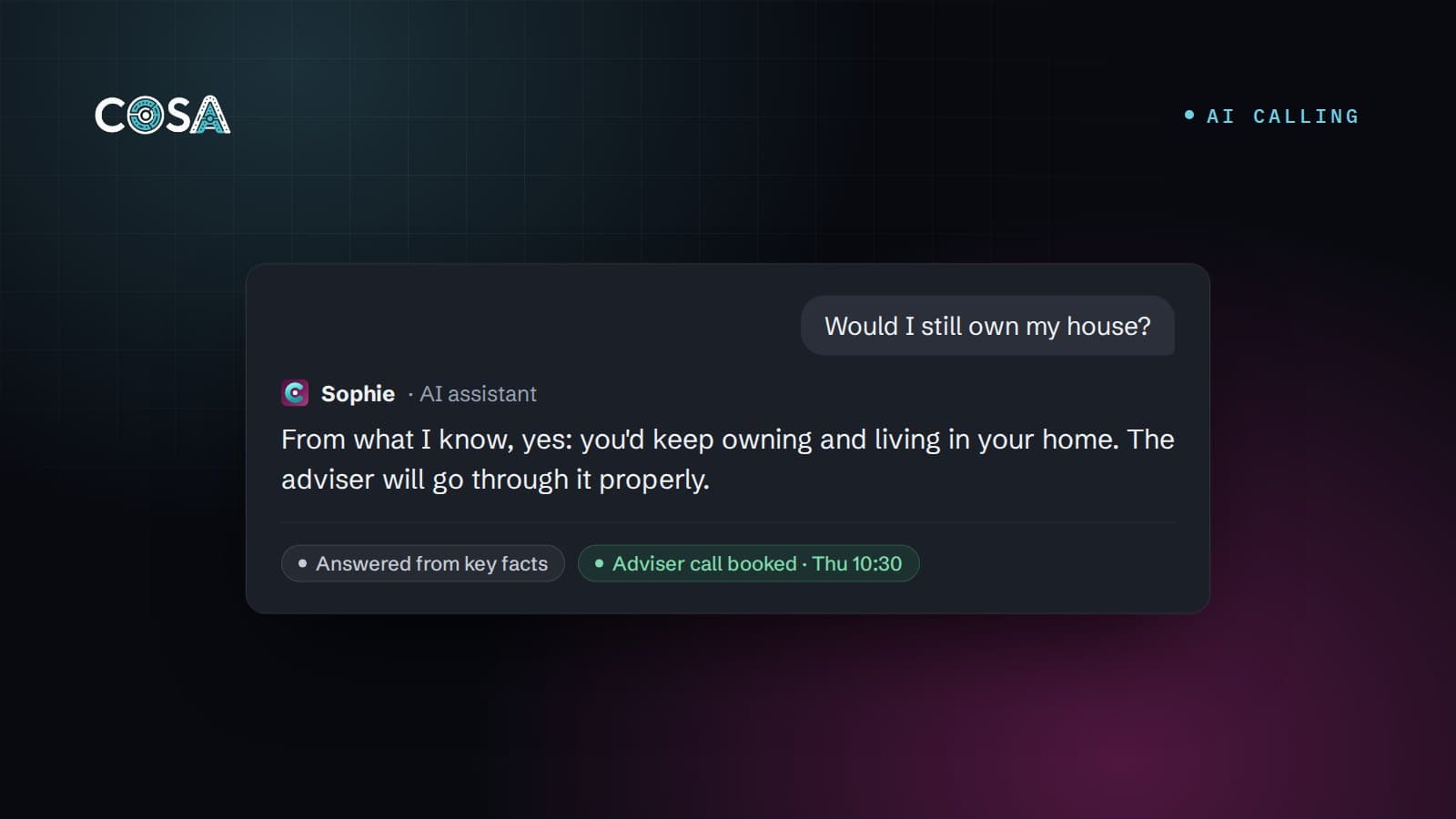
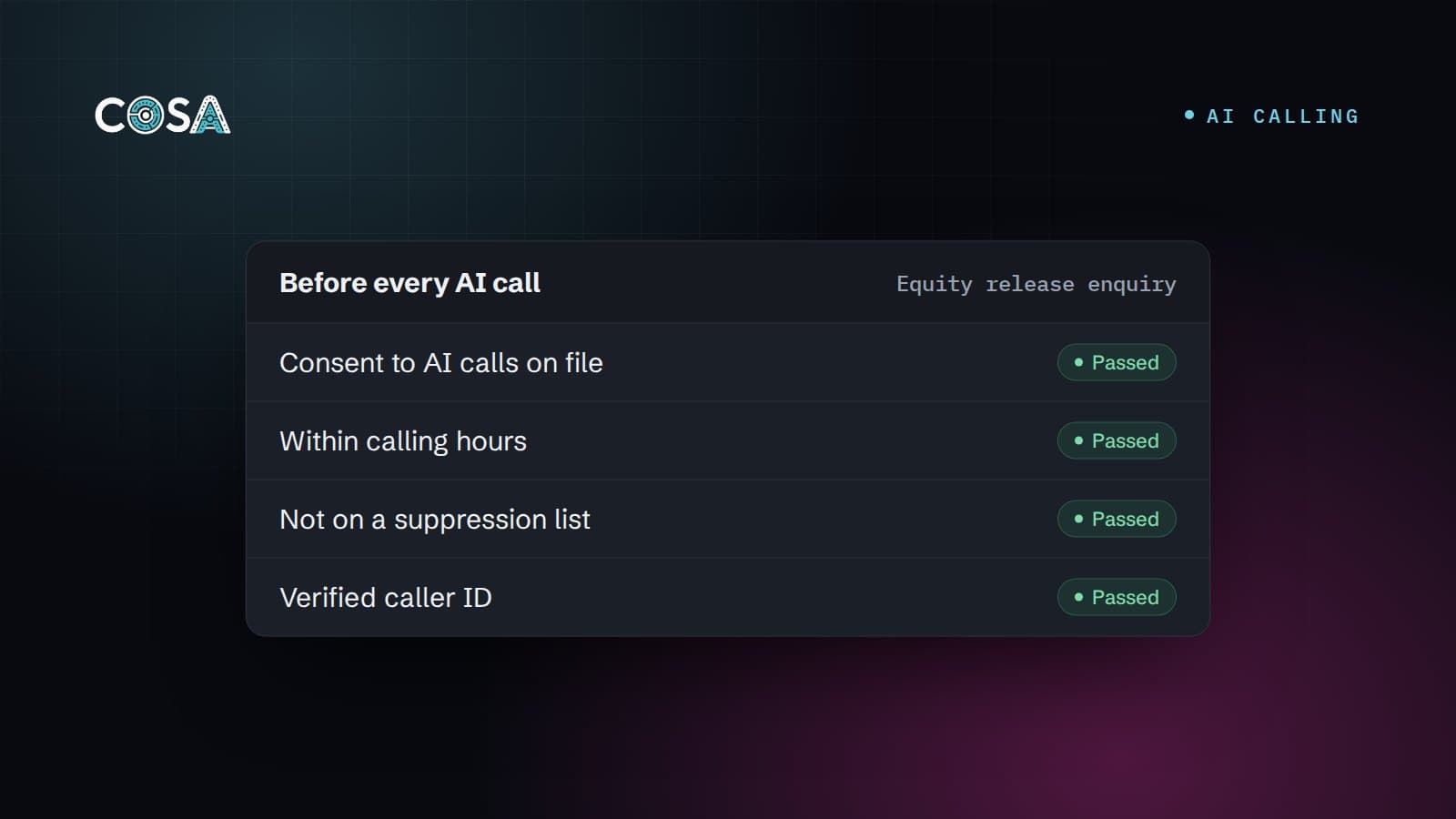
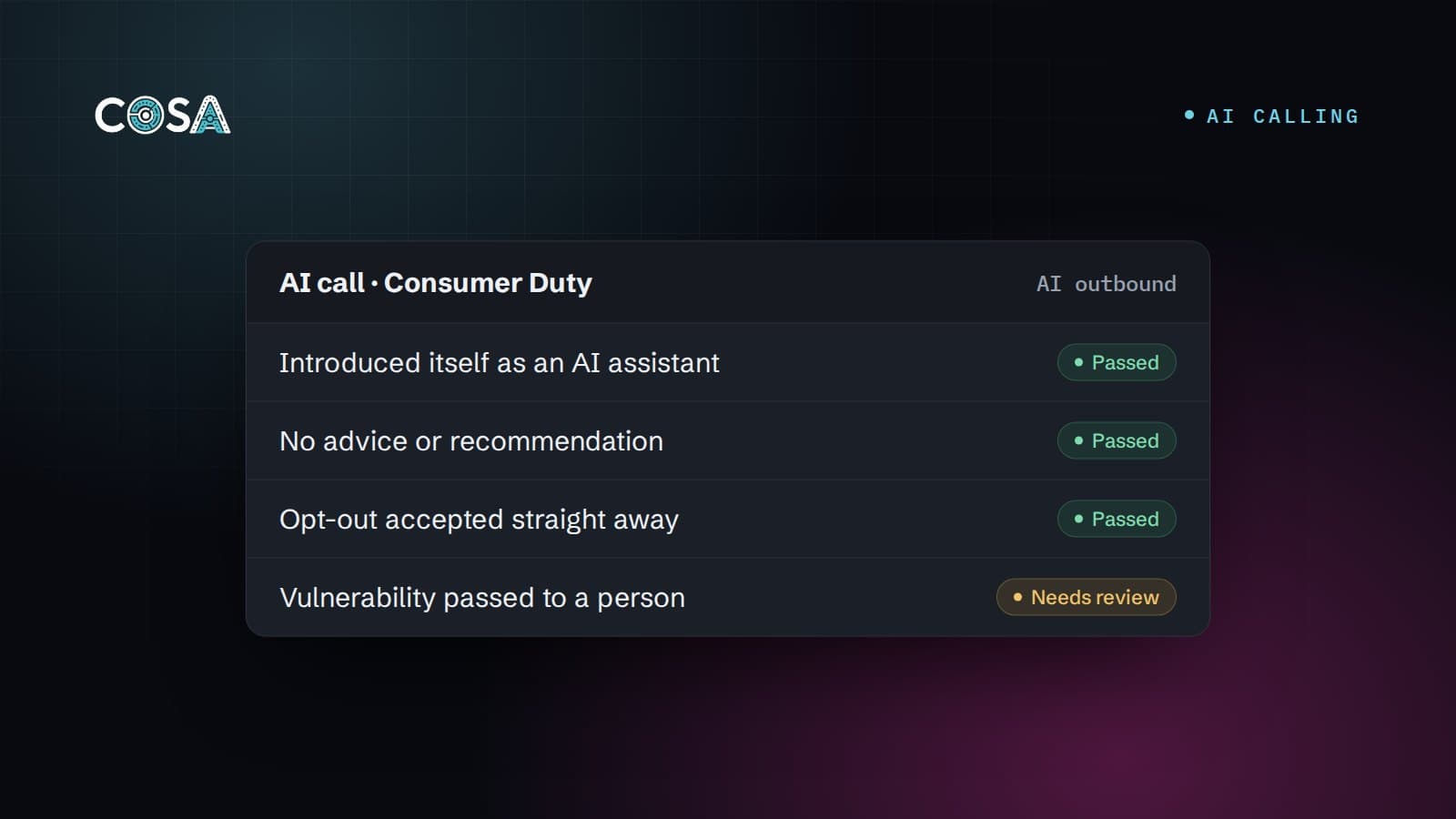
The COSA AI Dialler lets a firm run a campaign that calls new enquiries as they arrive, within the firm's calling hours: Monday to Saturday, 9am to 9pm at the widest, never Sundays or bank holidays. Before each call, COSA checks that the person consented to AI calls from the firm, made an express request and is not on a suppression list; if a check fails, the call is blocked. By default the AI agent introduces itself as an AI assistant. It answers questions from approved facts, never gives advice, and books a call into the adviser's Microsoft 365, Outlook or Google Calendar, or notes when the person would like a callback. See it applied to equity release enquiries.
This article is general information, not legal or regulatory advice. The research figures are quoted from the studies named and describe US companies in 2011 and earlier; they are not forecasts for any UK firm. Always check PECR, the ICO's guidance and the FCA Handbook for your firm's own obligations.