The consumer support outcome is one of the Consumer Duty's four outcomes, set out in PRIN 2A.6. Firms must design and deliver support that meets customers' needs, including those with characteristics of vulnerability, lets them use the product as reasonably anticipated, includes appropriate friction and puts no unreasonable barriers in their way. For phone-led advice firms, it applies after the sale as much as before it.
What is the consumer support outcome?
The core rule is PRIN 2A.6.2R, part of PRIN 2A. It requires a firm to design and deliver support that does four things:
| PRIN 2A.6.2R | What it asks | What it can mean on an advice call (illustrative) |
|---|---|---|
| (1) Meets the needs of retail customers, including those with characteristics of vulnerability | Support built around your actual customers | Adapting pace and language; offering a follow-up call or written summary when a client is struggling |
| (2) Enables customers to use the product as reasonably anticipated | Support does not stop at the sale | A client ringing after completion gets a clear answer and a named next step |
| (3) Includes appropriate friction to mitigate the risk of harm and give customers enough opportunity to understand and assess their options | Some friction is protective, and required | Time to think before a long-term decision; checking understanding before moving on |
| (4) Ensures customers do not face unreasonable barriers, including unreasonable additional costs, during the product lifecycle | No unreasonable barriers at any stage, including when customers want to change or leave | A client can pause, not proceed or complain without being passed around or pressed to reconsider |
PRIN 2A.6.6R adds a duty between firms: a firm must respond effectively and promptly to reasonable requests from other firms, so that those firms can support their own retail customers.
The FCA's guidance on the outcome is in Chapter 9 of FG22/5. FG22/5 describes the outcome's aim as reducing unnecessary and harmful barriers, or sludge, that unreasonably restrict customers from acting in their interests, while recognising that friction can play a positive role where it is in customers' interests.
Why it matters for advice firms
In our view, an advice firm's exposure sits mainly in post-sale contact, clients who want to pause or not proceed, complaints, and clients with characteristics of vulnerability, much of it on the phone. Our practical guide to the Consumer Duty covers all four outcomes.
What is sludge, and how is it different from appropriate friction?
Sludge is the FCA's shorthand for unnecessary and harmful barriers. Guidance in PRIN 2A.6 says unreasonable barriers are likely to make customers take unreasonable additional steps, such as steps that are:
- onerous or time-consuming;
- complex or hard to understand; or
- asking for information or evidence that isn't needed.
Unreasonable additional costs are not only financial. The guidance counts unreasonable exit fees or other charges, and also delays, distress and inconvenience.
Don't put existing customers behind new ones
The guidance also says a firm is unlikely to comply if its support leads to prospective customers being prioritised over existing ones, or to unreasonable delays when customers try to engage. Its example: disproportionately longer call waiting times to cancel or change an existing product than to buy a new one. PRIN 2A.6 does not set a fixed maximum wait; the question is whether delays are unreasonable.
Appropriate friction is not sludge
Limb (3) of PRIN 2A.6.2R requires appropriate friction, and the guidance says friction included for that purpose would not amount to an unreasonable barrier. For an advice firm, that might be giving a client time to think before a lifetime decision, or checking they have understood the key risks before moving on (see the consumer understanding outcome).
In our view, friction that helps a customer make a good decision is appropriate; friction that makes it harder to act on a decision already made is not. Where it is a judgement call, write down the reasoning.
What sludge can sound like on a call
| On the call (illustrative) | Why it may be a barrier | A better pattern |
|---|---|---|
| A client wants to pause or not proceed, and the adviser keeps re-pitching instead of recording the decision | Harder to act on their decision; distress | Confirm the decision, explain what happens next, record it |
| A client voices dissatisfaction, and it is not recognised as a possible complaint, or they are told to start again in writing | An extra, onerous step; the complaint may go unhandled | Recognise it on the call and follow the firm's complaints process |
| A bereaved client is asked to repeat details given on an earlier call | Unnecessary information; avoidable distress | Record needs once; check the file before the call |
| A client ringing to change or cancel is passed around, or promised a callback that never comes | Delay and inconvenience | A named owner and a time, kept to |
Our illustrations, not examples published by the FCA.
What did the FCA find in its consumer support review?
On 7 March 2025 the FCA published Consumer support outcome: good practices and areas for improvement, and on 10 July 2026 it updated the page with further examples of how smaller firms can meet the requirements. It drew on a May 2024 survey of 407 retail financial services firms (356 responded), then an information-gathering exercise with 40 firms of different sizes and business models in September 2024. Its examples are good practice, not new rules.
Good practice
These examples come from across retail financial services, not specifically from advice firms:
- reviewing end-to-end support journeys, using journey mapping or personas to find pain points and sludge;
- one firm programmed vulnerability-related keywords into its web chat to flag customers and move them into a high-priority queue;
- one firm used "Customer Advocacy" as a staff performance metric instead of productivity-based measures.
Areas for improvement
| What the FCA found | A question for an advice firm |
|---|---|
| Firms should not focus disproportionately on pre-sale over after-sale support, including where third parties provide it | Are follow-up and servicing calls held to the same standard as the fact find? |
| Longer waits for existing customers trying to terminate or downgrade | Is it as easy to pause, withdraw or change as it is to go ahead? |
| Some firms monitored support only through transactional metrics, such as contact rates and wait times, or only reactively through complaints and feedback | Does anyone check what was actually said on support calls? |
| Mixed progress on MI oversight of outsourced support providers | Is support provided by third parties covered by your MI? |
| Some firms could not evidence a customer-focused culture | What shows how clients are treated when they don't want to buy? |
In the survey, 13% of firms said they carry out no quality assurance on the support channels they offer. And 81% said their customer-facing staff have easy access to an internal mechanism for recording that a customer has disclosed, or been identified as having, characteristics of vulnerability.
How should you support vulnerable customers on a call?
The first limb of PRIN 2A.6.2R names customers with characteristics of vulnerability. Our guide to identifying vulnerable customers on calls covers FG21/1's four drivers; here the focus is on the support itself.
Recognise and respond
FG21/1 expects firms to make sure frontline staff have the skills and capability to recognise and respond to a range of characteristics of vulnerability. Cues it suggests staff watch for include a customer asking for information to be repeated, signs of confusion or not understanding, mention of medication, and shortness of breath or agitation. The aim is to notice and respond, not to diagnose.
In practice (our suggestions, not an FCA list): slow down, use plain language, offer a follow-up call or written summary, involve a trusted person where the client agrees, or refer to specialist support.
Tell us once
FG21/1 says firms should have systems and processes that let staff record and access the information needed to respond to a vulnerable customer's needs, so customers do not have to repeat it. It gives a "tell us once" approach to bereavement as an example. On the phone, check the file before the next call. Health information is special category data, so record what you need to support the client, limit who can see it, and make sure your DPIA covers it where one is needed.
What the FCA's vulnerability review found
Alongside its March 2025 review of firms' treatment of vulnerable customers, the FCA reported consumer research showing that 44% of customers in vulnerable circumstances had a negative experience with a financial services firm, against 33% of other customers. Only about 4 in 10 had told their provider about their circumstances; of those who had, 74% said the provider asked the right questions after they disclosed.
What does proportionate support look like for smaller, phone-led firms?
The July 2026 update says smaller firms may offer fewer support channels, for example relying mainly on telephone or email, but those channels need to work well: staff should be accessible, response times reasonable, and customers able to raise issues or get help easily, including when their needs change.
On monitoring, it suggests that smaller firms without tools such as speech analytics can use proportionate methods, such as periodic call listening or file reviews against a simple checklist:
- Were the customer's needs identified?
- Was appropriate support given?
- Was the issue resolved without repeat contact?
Firms can also use existing data, such as complaints, repeat contacts and feedback.
They map onto advice calls, with two cautions. A small listening sample can easily miss a failure that affects a few calls in a hundred: the maths of call QA sampling and the sample size calculator show how much. And a recording shows the conversation, not the wait before it, so pair it with your telephony data.
How do you evidence consumer support from your calls?
Call evidence helps fill the gap the FCA found in transactional-only monitoring: what happened when a client asked for help, wanted to stop or was struggling. Four steps, within wider Consumer Duty outcomes monitoring:
1. Turn the outcome into checkable rules
"Client was well supported" cannot be checked consistently. Specific behaviours can (see writing compliance rules an AI can check):
| What to check | Rule type | Call types |
|---|---|---|
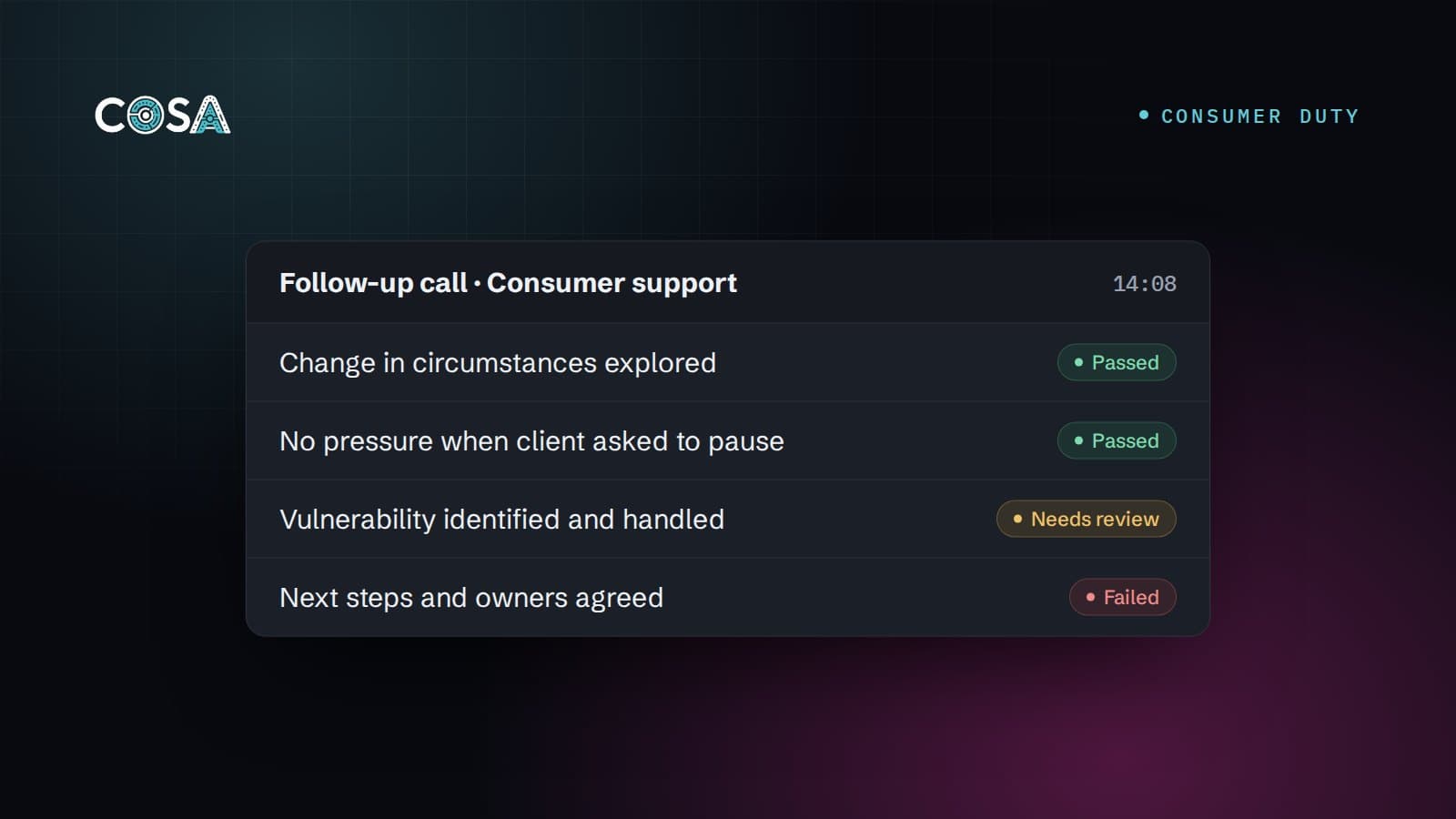
| Needs, or changes in circumstances, explored | Non-verbatim | Follow-up, initial contact |
| No pressure when a client wants to pause, delay or not proceed | Objection handling | Fact find, follow-up |
| Signs of vulnerability noticed, and the response recorded | Vulnerability detection | All |
| Dissatisfaction recognised and handled under the complaints process | Non-verbatim | All |
| Next steps and owners agreed | Non-verbatim | All |
Illustrative rules; write your own to match your processes.
2. Measure after-sale calls, not just advice calls
Apply support rules to follow-up calls as well as fact finds, so you can answer the pre-sale versus after-sale question with data. A written call-selection policy makes clear which calls are covered.
3. Keep the evidence
For each finding, keep the quoted passage, the reviewer's decision and any override with its reason.
4. Report, act and re-measure
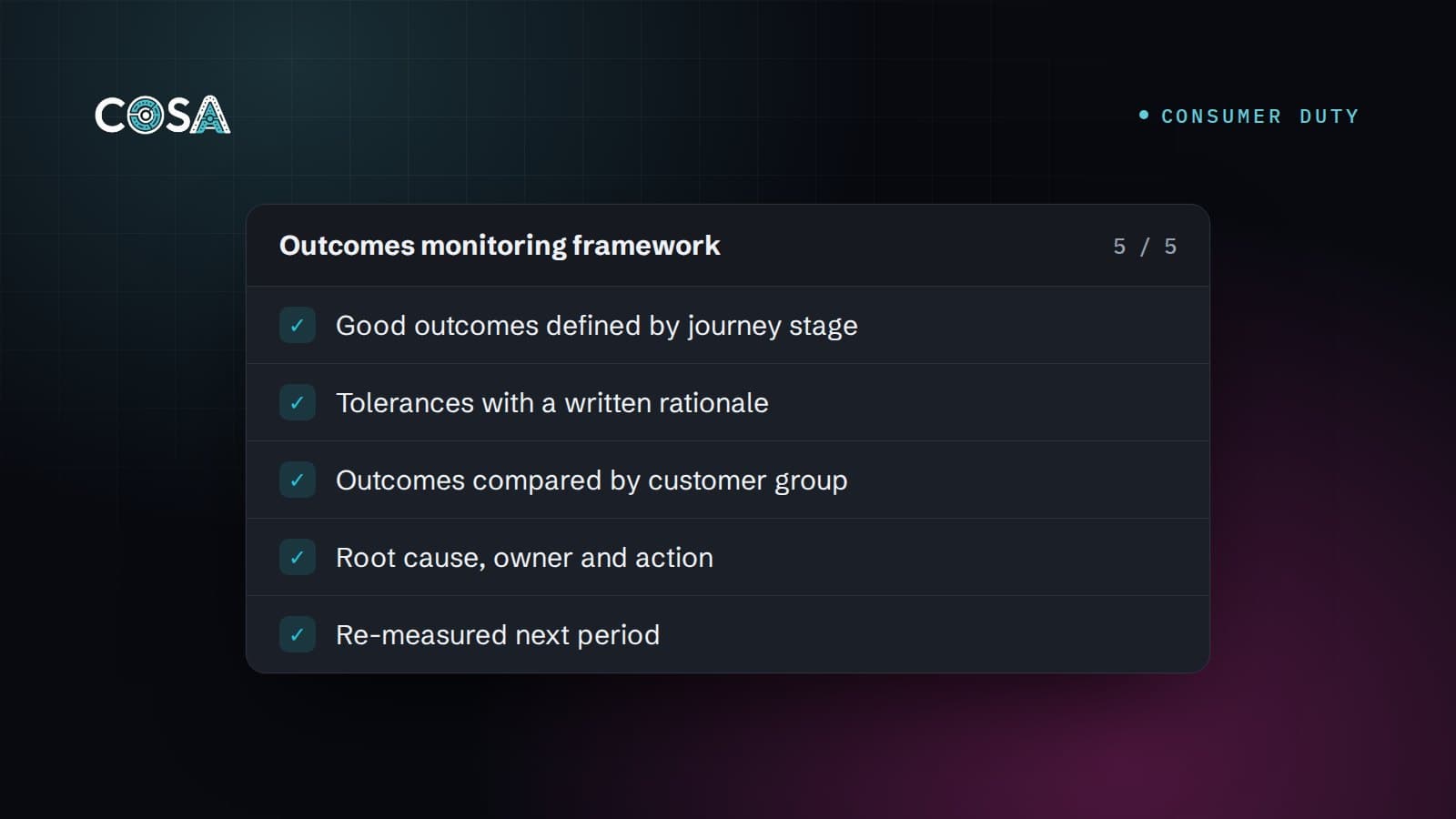
Report support results by adviser and call type, the most-failed support rules, and vulnerability flags with how each was handled, alongside wait times, missed calls and complaints. Feed failures into coaching, script changes and complaints root cause analysis, then check the next period's results. Our guides to compliance MI and Consumer Duty board reports cover the reporting side.
COSA covers the conversation part of this. It assesses finished, recorded calls against your firm's own rules, applied to the call types you choose, with a written explanation, quoted evidence and a confidence level behind every verdict; reviewers can override, and the original is kept for audit. Vulnerability rules flag possible signs for a person to decide on, and the COSA Assistant answers questions about a client's calls, such as what they have already disclosed, with cited passages. It does not measure queues or wait times, and it supports, rather than replaces, professional compliance review. See how COSA supports the Consumer Duty.
A consumer support checklist for phone-based advice teams
| # | Check | Basis |
|---|---|---|
| 1 | Follow-up and servicing calls are held to the same standard as the fact find | FCA review findings |
| 2 | Pausing, changing, withdrawing or complaining is no slower or harder than going ahead | Guidance in PRIN 2A.6; our suggestion |
| 3 | Friction you keep is there to protect clients, and the reason is written down | PRIN 2A.6.2R(3); our suggestion |
| 4 | Staff recognise vulnerability cues and respond, and the response is recorded | PRIN 2A.6.2R; FG21/1 |
| 5 | Needs are recorded so clients do not have to repeat difficult information | FG21/1 |
| 6 | Every call ends with clear next steps and an owner | Our suggestion |
| 7 | Dissatisfaction is recognised as a possible complaint on the call | Our suggestion |
| 8 | QA covers support calls, not just wait times and complaint volumes | FCA review findings |
| 9 | Support provided by third parties is covered by MI | FCA review findings |
| 10 | Findings have owners and dates, and are re-measured | Our suggestion |
If you score calls, these checks slot into a call QA scorecard; for equity release, see evidencing good outcomes.
This article is general information, not legal or regulatory advice. It reflects PRIN 2A.6, FG22/5, FG21/1 and the FCA's published good-practice material as at 13 October 2026; the FCA's good-practice examples are not requirements. Always refer to the FCA Handbook and the FCA's own guidance for your firm's obligations.