The consumer understanding outcome is one of the Consumer Duty's four outcomes, set out in PRIN 2A.5. Firms must make sure their communications meet customers' information needs, are likely to be understood and equip them to make effective, timely and properly informed decisions. In practice, on an advice call, that means tailoring the explanation, checking it landed and being able to show that you did.
What is the consumer understanding outcome?
The Consumer Duty's rules for this outcome are in PRIN 2A.5, part of PRIN 2A. A firm must support its customers' understanding so that its communications:
- meet customers' information needs;
- are likely to be understood by them; and
- equip them to make decisions that are effective, timely and properly informed.
Communications must also be clear, fair and not misleading. The outcome applies before, during and after a sale, in every channel. The rules expressly cover one-to-one conversations, including on the phone, so what an adviser says on a call is a communication in its own right, alongside documents such as the key facts illustration.
The FCA's guidance on this outcome is in Chapter 8 of FG22/5. Our practical guide to the Consumer Duty shows how the four outcomes fit together.
What does PRIN 2A.5 require on an advice call?
Tailoring the explanation
PRIN 2A.5 lists factors a firm should take into account in deciding what to communicate and how:
| Factor in PRIN 2A.5 | What it can mean on an advice call (illustrative) |
|---|---|
| The customers' characteristics, including any characteristics of vulnerability | Slowing down, breaking information into smaller pieces, or offering a written summary or a second call |
| The complexity of the product | Spending longer on what drives cost and risk, such as how interest rolls up on a lifetime mortgage |
| The communication channel | On the phone there is nothing to point at, so key figures may need repeating and confirming in writing |
| The role of the firm | An adviser is explaining a personal recommendation, not just describing a product |
The one-to-one rule
When a firm deals with a customer one to one, such as in a branch, on the phone or in another interactive dialogue, PRIN 2A.5 says it must, where appropriate:
- tailor the communication to that customer's information needs, taking into account whether they have characteristics of vulnerability; and
- ask the customer whether they understand the information and whether they have any further questions.
This is the part of the outcome that most directly describes an advice call. It requires a question about understanding, but does not prescribe how to ask it, which leaves room for a better question than "Does that make sense?"
Testing communications and monitoring their impact
Where appropriate, firms must test communications before they reach customers and regularly monitor their impact afterwards. The guidance alongside the rules says firms should adapt communications where there are areas of common misunderstanding or customers are not getting good outcomes, and investigate and correct deficiencies. It also says that a notably different response from the one anticipated to a communication prompting customers to act, such as a notably lower response rate, suggests the communication has not been understood.
For an advice firm, it makes sense to treat the adviser's script and standard explanations as communications to test, not just letters. Monitoring their impact is part of wider outcomes monitoring.
What "where appropriate" means in practice
The one-to-one and testing rules apply "where appropriate", and the standard is that communications are likely to be understood, so the obligation is proportionate: a two-minute call to rebook an appointment is not a fact find. In our view, though, an advice call about a complex, long-term product is exactly the kind of interaction the one-to-one rule has in mind, and checking understanding of the key points will nearly always be appropriate.
What did the FCA's March 2026 consumer understanding review find?
On 13 March 2026 the FCA published Consumer understanding: good practice and areas for improvement, based on a survey of 38 firms in September 2025 across insurance, retail banking, payments, consumer finance and CFD providers. It covers five areas: management information and testing, innovation and communication design, vulnerability and accessibility, financial promotions, and governance and oversight.
The FCA says the examples are not intended to create new requirements; firms should use them to assess their own approach. The rules are in PRIN 2A.5, and the FCA's guidance on them is in Chapter 8 of FG22/5. Advice firms were not among the sectors named, but the themes carry over.
| Theme | Good practice in the review | Areas for improvement |
|---|---|---|
| Insight | Several sources, including call listening, complaints, chat transcripts, website analytics, drop-off data and surveys, reviewed regularly, with improvements prioritised on evidence rather than assumptions | Relying on sales data or the absence of complaints as evidence of understanding, which gives no reliable assurance |
| Testing | Testing before and after changes with proportionate tools (surveys, comprehension checks, A/B testing, frontline feedback), and checking whether changes improved understanding | Superficial, one-off or poorly documented testing; some firms did not test with customers at all, or used very small, unrepresentative groups |
| Changes | Documenting what changed, why, and the impact | Cosmetic changes that did not address the root cause; changes not checked to see if they worked, and records not showing what changed, why or the impact |
| Measures | One firm tested communications with customers in vulnerable circumstances and measured comprehension against its own target of at least 80% correct recall of key points | Many firms lacked comprehension measures or acceptability targets |
| Governance | Clear ownership of the outcome, defined governance, regular review of MI and tracking of actions so that decisions lead to improvements | Unclear accountability for the outcome and too little use of MI to inform decisions; the FCA suggests committees receive comprehension-driven KPIs, not just compliance, sentiment or activity metrics |
The 80% figure was one firm's own benchmark, not an FCA standard.
What it means for an advice firm
Call listening is one of the insight sources in the FCA's good practice, and for an advice firm the recording is where the explanation happens. "We have had no complaints" is not evidence of understanding; complaints analysis is one input among several. And a script or training change is only half done until you have checked whether it worked.
Is asking "Do you understand?" enough? Checking understanding with teach-back
The one-to-one rule asks firms to ask, and how you ask matters. Health-literacy guidance from the US Agency for Healthcare Research and Quality (AHRQ) notes that "Do you understand?" often gets a yes even when the person has not understood.
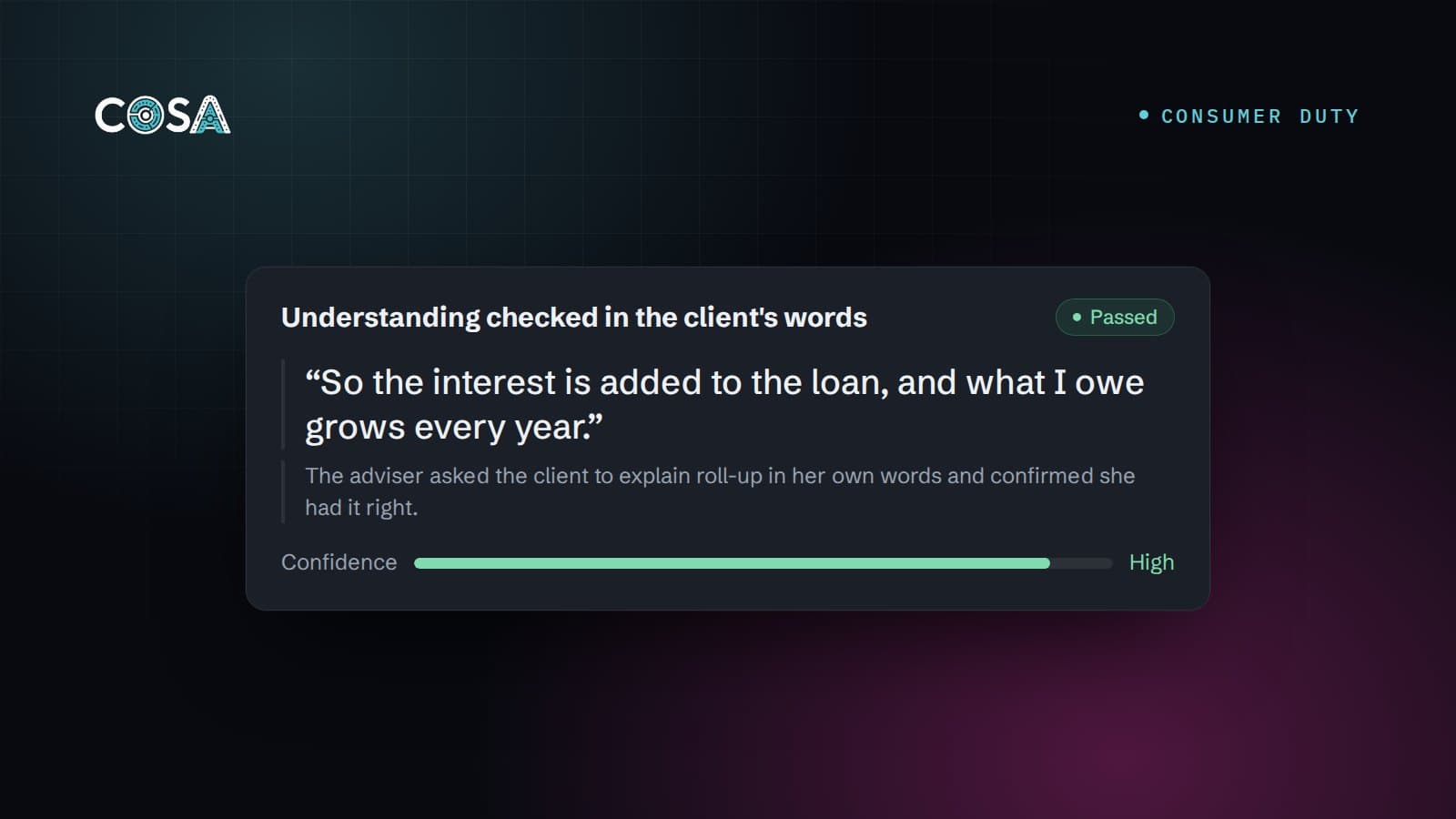
Teach-back, described in the AHRQ's health literacy toolkit, asks the person to explain the key point in their own words, using open "what" or "how" questions. If there is a gap, you explain again and check again. It tests how well the explanation was given, not the person.
The FCA does not require teach-back by name. It is a stronger way of doing what the one-to-one rule does require, and a customer's own account of a key point, on the recording, says more than a "yes". The FCA's review gives a similar technique as good practice in a different context: testing financial promotions by asking customers to explain the main message in their own words.
Teach-back prompts for later-life lending calls
| Key point | Instead of | Try |
|---|---|---|
| Interest roll-up | "Does that make sense?" | "Just so I know I've explained it well, how would you describe what happens to the amount you owe over time?" |
| Early repayment charges | "Are you happy with that?" | "In what situations might you have to pay a charge if you repaid early?" |
| Effect on the estate | "Any questions on that?" | "What would this mean for what you leave to your family?" |
| Means-tested benefits | "OK so far?" | "How might the money you release affect any benefits you receive?" |
Illustrative prompts. Adapt them to your products, customers and standards.
Framing the check as a test of the adviser's explanation, as in the first example, keeps it respectful, which matters most with a customer who is struggling. After the answer, the adviser corrects any gap, checks again, then asks whether the customer has any further questions.
Signs a customer has not understood
The FCA's guidance on vulnerable customers, FG21/1, lists signs staff can watch for, including a customer asking for information to be repeated, which can mean they are not retaining it, and signs that they have not understood or are confused. When they appear, adapt: slow down, break the information up, offer a written summary or a second call, and record what you did. See identifying vulnerable customers on calls and the consumer support outcome.
How to test scripts and explanations proportionately
Proportionate options from the FCA's examples include:
- Comprehension checks and short surveys with customers, before and after a change.
- Post-sale comprehension calls. One smaller firm in the review used a short questionnaire to confirm customers understood key aspects of the product, such as monthly payments, term length and what to do if they fell behind.
- Frontline feedback about where customers get stuck.
- Call listening against a simple checklist. The FCA's consumer support good-practice page suggests smaller firms without sophisticated tools could use periodic call listening or file reviews with a simple checklist.
- Explain-it-back tests of written material. A smaller firm in the review asked a few customers or colleagues to read a financial promotion and explain it back.
Decide in advance what "understood" looks like: on calls, perhaps the share of fact finds where the customer correctly put roll-up into their own words. If you set a target, make it your own. Record what you changed, why, and what happened afterwards. And fix the explanation, not just the wording: organise it around the decision the customer has to make, not around a shorter script.
How to evidence consumer understanding from your calls
The FCA's good-practice work on outcomes monitoring makes the point that collecting data, listing metrics or reporting MI will not, by itself, show whether customers are getting good outcomes. Firms should be able to explain what their information shows, how they act on it and whether those actions worked. On advice calls, that suggests four steps.
- Turn the outcome into observable rules. "Customer understands the advice" cannot be checked consistently. "Adviser asks the customer to explain a key feature in their own words, and corrects any misunderstanding" can, as can rules that key points were explained and that signs of confusion were handled. See writing compliance rules an AI can check and the equity release fact find checklist.
- Apply them consistently. Assess every in-scope call against the same rules where you can, or be able to explain why your sample is enough (see how many calls to review). Log exclusions with a reason, and keep quoted evidence and reviewer overrides on the audit trail.
- Look for patterns. Which key points are most often left unexplained or unchecked: one adviser, one call type, long calls? Gaps repeated across advisers point to the script or training, not the individual.
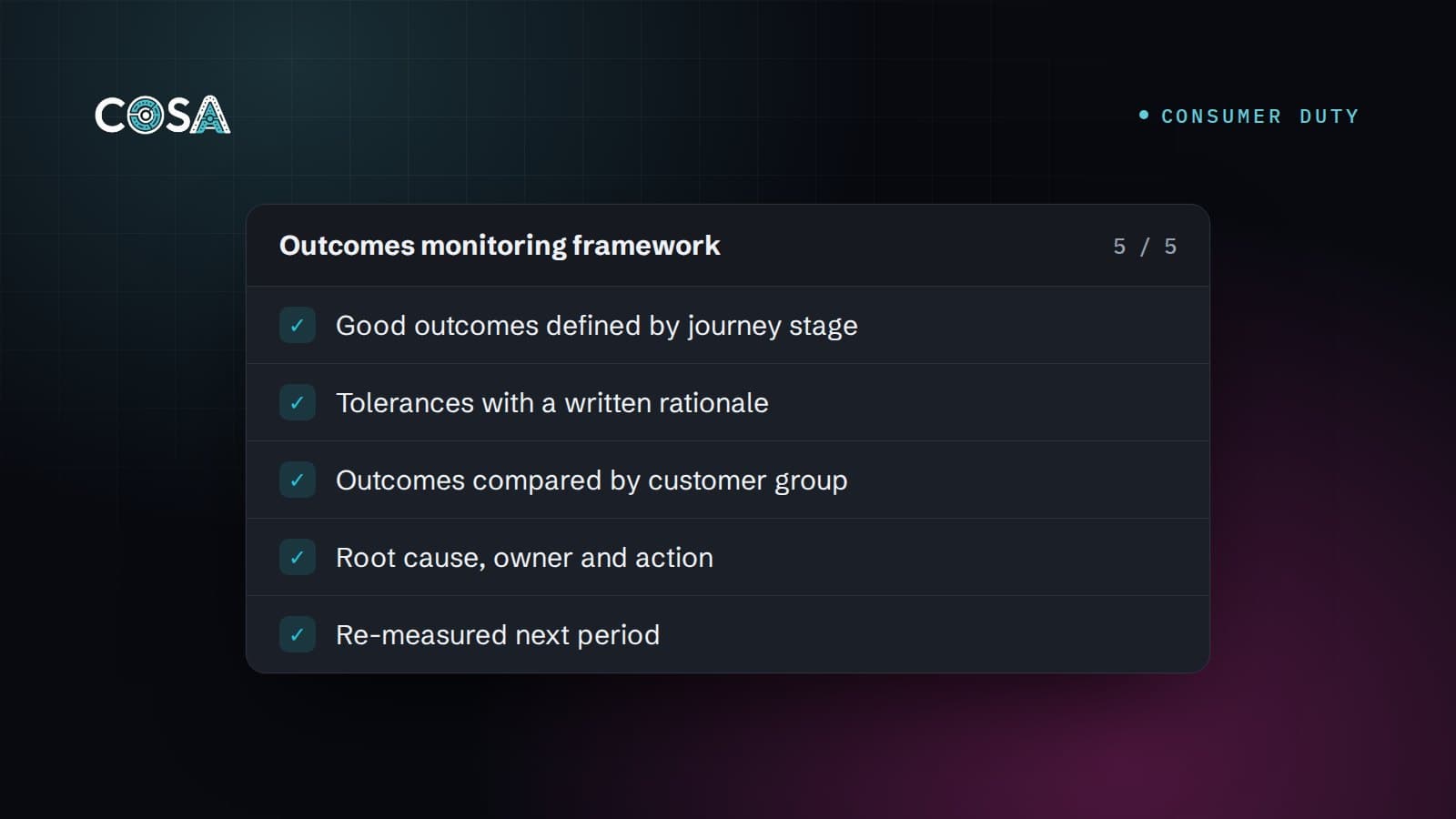
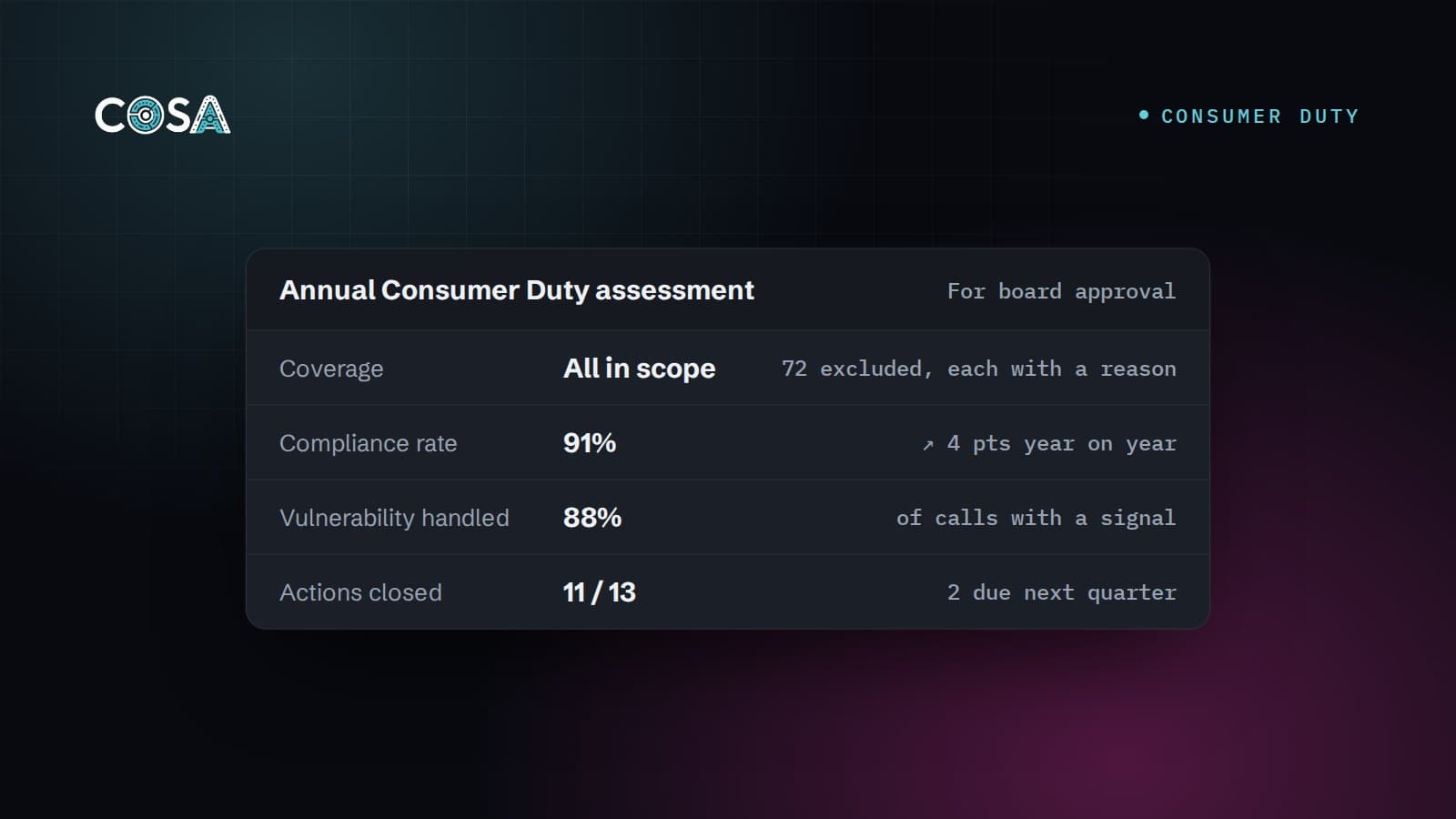
- Close the loop and report it. Change the script, training or documents, check whether the next period's results improve, and take comprehension-focused measures to governance with named owners, target dates and status. Our guides to compliance MI and Consumer Duty board reports cover the reporting side.
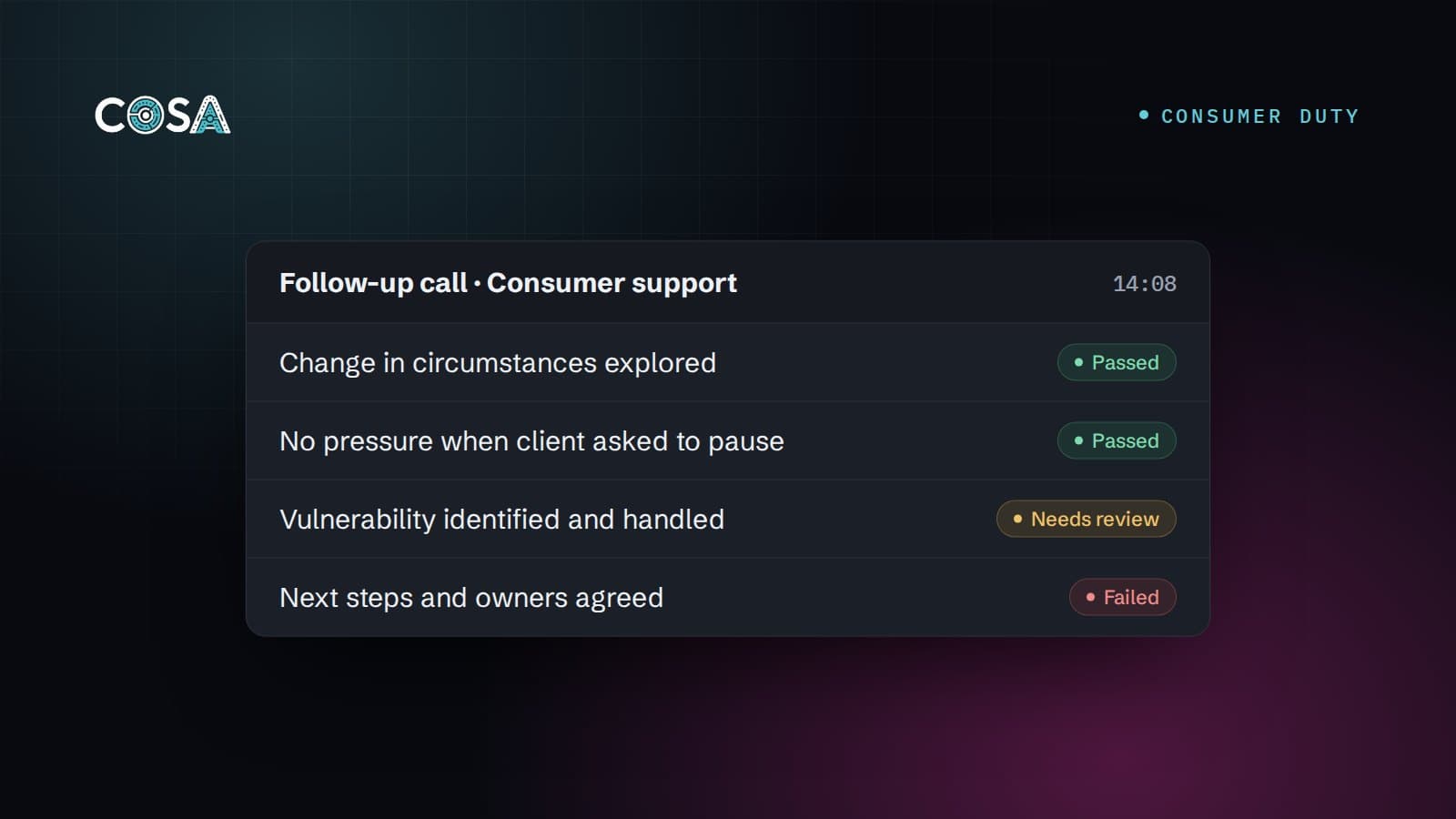
COSA supports this on recorded calls. It assesses finished calls against your firm's own rules, such as "understanding checked in the customer's own words", and gives each in-scope call a verdict of Passed, Needs review or Failed, with a written explanation, quoted transcript evidence and a confidence level; authorised reviewers can override a verdict. MI dashboards show outcomes by adviser and call type and the most-failed rules, so you can see whether a script change made a difference, and the COSA Assistant answers questions about a client's calls, citing the passage. It does not test communications with customers or measure comprehension, and it supports, rather than replaces, professional compliance review. See how COSA supports the Consumer Duty.
A consumer understanding checklist for advice calls
| # | Check | Basis |
|---|---|---|
| 1 | Key information for each call type is defined and written as checkable rules | Our suggestion |
| 2 | Explanations are tailored to the customer, including any characteristics of vulnerability | PRIN 2A.5 |
| 3 | The adviser checks understanding of key points, ideally in the customer's own words, and corrects any gap | PRIN 2A.5 (asking); teach-back (AHRQ) |
| 4 | The customer is asked whether they have any further questions | PRIN 2A.5 |
| 5 | Signs of confusion lead to an adapted approach, and what was done is recorded | FG21/1; PRIN 2A.5 |
| 6 | Scripts and standard explanations are tested where appropriate, and changes are documented | PRIN 2A.5; FCA good practice |
| 7 | Call listening, complaints and frontline feedback are reviewed together for common misunderstandings | FCA good practice |
| 8 | Sales data and a lack of complaints are not treated as evidence of understanding | FCA review findings |
| 9 | It is clear who owns this outcome, and comprehension-driven MI reaches governance, with actions tracked to completion | FCA good practice |
If you score calls, these checks slot into a call QA scorecard.
This article is general information, not legal or regulatory advice. It reflects PRIN 2A.5, FG22/5 and the FCA's published good-practice material as at 13 October 2026; the FCA's good-practice examples are not requirements. Always refer to the FCA Handbook and the FCA's own guidance for your firm's obligations.