A call QA scorecard, or call monitoring form, is the form a reviewer uses to check a recorded call against the firm's standards, item by item, with evidence for each result. For FCA-regulated advice calls, a good template covers disclosures, needs, alternatives, costs and risks, vulnerability, understanding, next steps and conduct, keeps a short list of critical fails, and records whether the customer's outcome was good.
What is a call QA scorecard?
A call QA scorecard lists what a reviewer checks and how each item is judged, with evidence behind every result. Scored consistently, results can be compared across calls, advisers and months.
For regulated advice, the scorecard has to test what the customer got from the call, not only whether the adviser followed the process. In FG18/2, its guidance on staff incentives in consumer credit firms, the FCA said process-based quality monitoring is unlikely to detect that a process has led to poor outcomes, and that process monitoring is not sufficient on its own. In its good and poor practice examples on vulnerable customers, it found some firms monitored only readily available data, such as whether staff handled calls in line with the firm's processes, which does not directly measure customer outcomes.
Nothing in the FCA material we reviewed prescribes a scorecard format, scoring method, pass mark or list of critical fails; those are the firm's design choices, and the template below is a starting point.
What should a call monitoring form include?
Start with header fields: call ID or recording link, date, call type (such as initial contact, fact find or follow-up), adviser, reviewer, review date, whether the call is in scope (and if not, why), and a client reference so one client's calls can be read together.
Then score items in eight sections: opening and disclosures; needs; alternatives; product, costs and risks; vulnerability; understanding; outcome and next steps; and conduct. Several reflect FCA findings:
- Needs and alternatives. In its 2020 review of equity release advice, the FCA found file evidence indicating advisers "largely adopted a form-filling approach to fact finding". Some relied solely on customers' initial stated preferences, and alternatives were "discounted with little consideration".
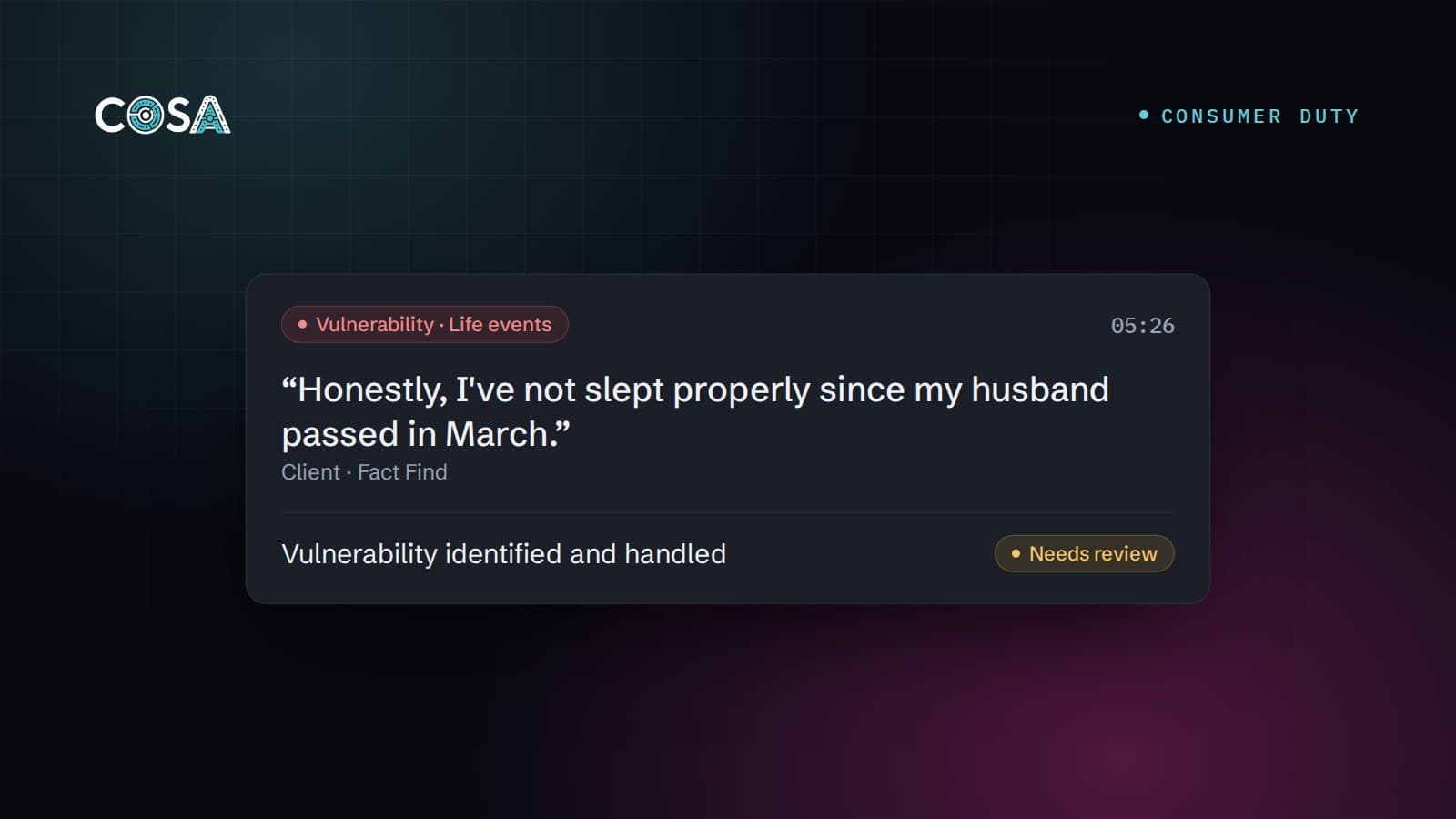
- Vulnerability. FG21/1 expects frontline staff to have the skills and capability to recognise and respond to different forms of vulnerability. Listen across its four drivers and for how the adviser adapted (see identifying vulnerable customers on calls).
- Understanding. The FCA's consumer understanding review said several firms relied on sales data or an absence of complaints as evidence of understanding, which does not provide reliable assurance. Score a teach-back, not "Does that make sense?". More in the consumer understanding outcome.
- Outcome and next steps. For smaller firms, the FCA's consumer support good practice suggests proportionate methods such as periodic call listening or file reviews using a simple checklist: were customer needs identified, was appropriate support provided, and were issues resolved without repeat contact? See the consumer support outcome.
The template
| Section | Criterion | How to evidence | Scoring guidance | Critical fail? |
|---|---|---|---|---|
| Opening and disclosures | Required disclosures given, such as the scope of the service and how the firm is paid | Timestamp and wording | Met if each disclosure your policy requires is given before advice | Yes |
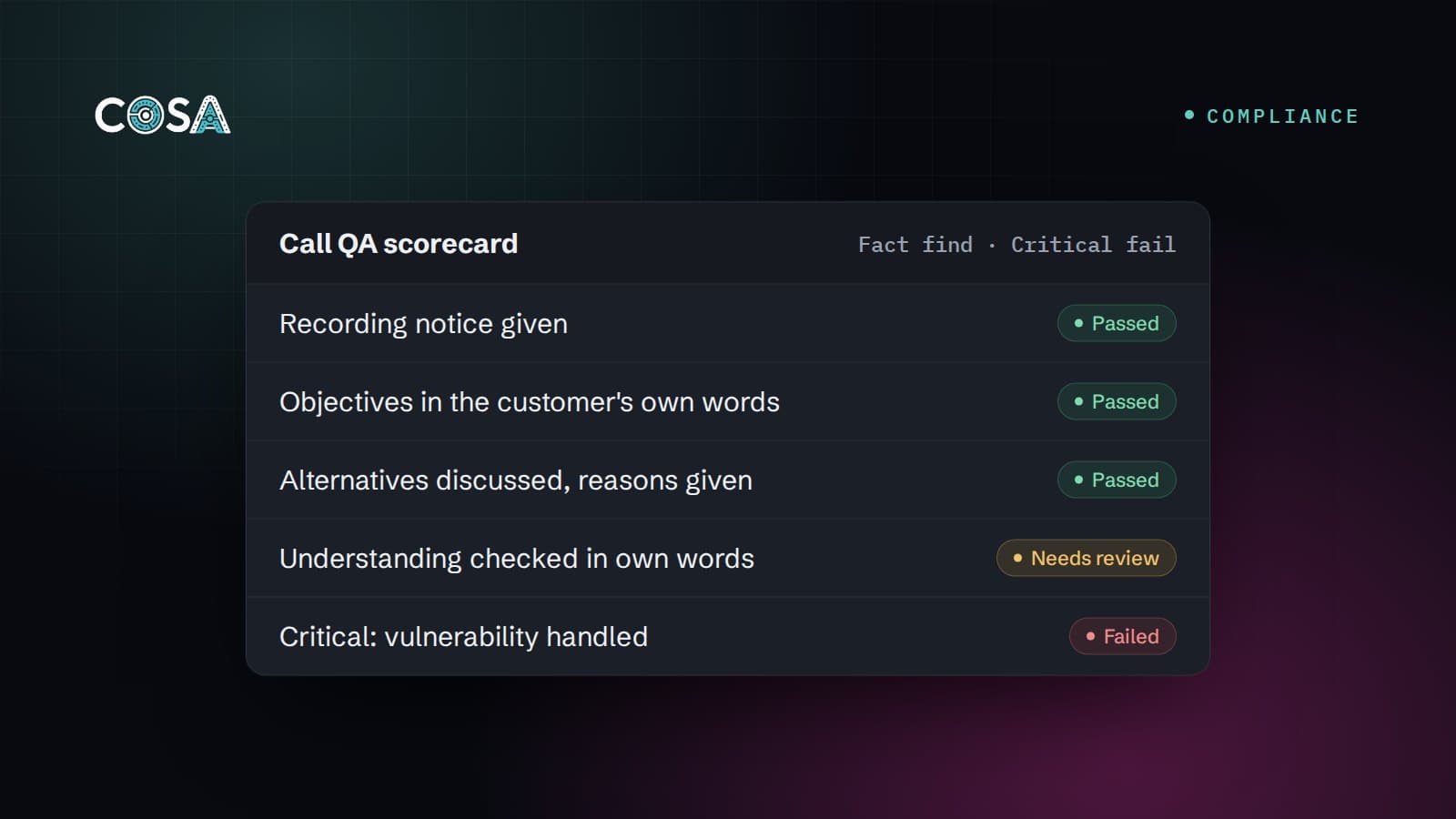
| Opening and disclosures | Recording notice given | Timestamp and wording | Met if the scripted wording or an approved variant is used | No |
| Opening and disclosures | Anyone else on the call identified, with the customer's agreement | Who they are and their role | N/A if no one else is present | No |
| Needs | Objectives in the customer's own words | The customer's words | Not met if form answers are only read back | No |
| Needs | Circumstances explored beyond the form | Follow-up questions asked | Met if answers that affect suitability are followed up | No |
| Alternatives | Stated preference tested, not taken as given | The adviser's check or challenge | Not met if the call goes straight from request to product | No |
| Alternatives | Alternatives discussed, with reasons for discounting them | Each alternative and its reason | Reasons relate to this customer, not generic text | No |
| Alternatives | Advice within the adviser's and firm's permitted scope | The statement in question | Not met if advice strays outside scope | Yes |
| Product, costs and risks | How the product works explained | The explanation | Each feature your policy lists is covered | No |
| Product, costs and risks | Costs and charges explained, including any that apply later | Quote, with figures checked against documents | Each relevant charge covered; figures match | No |
| Product, costs and risks | Key risks explained | Quote of each risk | Each risk your policy lists is covered | No |
| Product, costs and risks | No material misstatement of costs, risks or features | The statement and the correct position | Any material misstatement fails the call | Yes |
| Vulnerability | Signs of vulnerability noticed, and the adviser adapted | The signal and the adviser's response | N/A if no signs; Not met if a sign is missed or talked over | Yes |
| Understanding | Understanding checked in the customer's own words | The customer explaining a key point back | "Does that make sense?" alone is Not met | No |
| Outcome and next steps | Needs met, with nothing left that needs a repeat contact | Summary and agreed actions | Not met if the customer must come back to get something done | No |
| Outcome and next steps | Next steps agreed: who does what, by when | The summary | Both sides' actions stated | No |
| Conduct | No pressure to proceed; time to decide offered | Any urgency, deadline or incentive used | Any pressure fails the call | Yes |
| Conduct | Questions and concerns dealt with in substance | The concern and the answer | Not met if a concern is dismissed or deflected | No |
| Overall | Outcome verdict: good outcome, outcome at risk or poor outcome | Reviewer's reason, citing the items | Recorded on every call, alongside any score | n/a |
Illustrative, not an FCA format. Scope each item to the call types it applies to.
Download the scorecard template (CSV), with blank columns for the result, evidence and reviewer notes. For equity release, add the product points from our fact find compliance checklist.
How many items should a scorecard have?
There is no right number. Cover the risks on that call type, check one thing per item, and scope items so an initial contact isn't failed for missing fact-find items. Keep verbatim checks for scripted wording. The advice on writing compliance rules an AI can check applies to human scorecards too.
Should a QA scorecard be pass/fail or weighted?
| Approach | How it works | Good for | Watch out for |
|---|---|---|---|
| Binary | Met, Not met or N/A for each item | Compliance items; consistency between reviewers | N/A needs a definition, or good calls fail on items that didn't apply |
| Scaled | A rating, such as 1 to 5, for each item | Coaching softer skills | More room for reviewers to disagree; don't add different scales into one total |
| Weighted | Sections weighted to add up to 100% | Trend lines over time | A high total can hide one harmful failure |
A practical design uses binary items backed by evidence, plus a separate outcome verdict recorded alongside any score. The FCA's outcomes monitoring good practice describes firms using "QA breach categories and QA scoring approaches that highlighted incorrect customer outcomes, providing a clear trigger for further review and action".
As an illustration, if the template were scored as a plain total without critical fails, a call meeting 17 of its 18 items would score 94%. If the missed item were a bereavement the adviser talked over, the customer may still have had a poor outcome.
So what is a good QA score? There is no regulatory benchmark. If you report one, set the threshold yourself, write down why, and show it next to the critical-fail rate and the outcome verdicts. Our guide to Consumer Duty outcomes monitoring covers justifying tolerances.
What is a critical fail (auto-fail) in call QA?
A critical fail is an item serious enough that missing it fails the whole call, whatever else the scorecard says. It sits outside any total, so it can't be averaged away. The firm sets the list: the five marked in the template (missing disclosures, advice outside scope, material misstatements, mishandled vulnerability and pressure) are examples.
Before adding an item, check that it is severe (likely to cause harm), objective (two reviewers would agree), observable in the recording and within the adviser's control. If not, make it an ordinary item.
FG18/2 gives a good practice example of this kind of gate. A consumer credit lender ran monthly QA on a sample of calls, assessing both process and customer outcome. A staff member whose overall score fell below target received no bonus that month, and any call with a severe breach likely to cause customer harm disqualified them from the bonus regardless of their QA scores on other calls. FG18/2 is consumer credit guidance; we use it only to illustrate a breach no score can offset. Linking pay to QA results is a separate decision, with its own risks.
After a critical fail, escalate within a set timeframe, review the client's other calls and file, decide whether anything needs putting right for the customer, and record the root cause, as you would for complaints root cause analysis. Categorise each fail as a customer outcome at risk or a process breach, so your MI shows which problems affected customers.
How do you run a QA calibration session?
If two reviewers score the same call differently, trends, adviser comparisons and the board MI built on them can't be trusted.
- Pick a few calls, including borderline ones and a likely critical fail.
- Score independently, with evidence.
- Compare item by item, not on totals: identical totals can hide opposite judgements.
- Fix the item, not the result. Rewrite ambiguous items and add a pass and a fail example.
- Record the outcome: agreed results, wording changes and the date.
Run sessions regularly and whenever a script or item changes, and track agreement item by item. We know of no FCA rule or guidance setting a target for agreement between reviewers, so set your own and explain it.
Calibration also supports competence. For staff within the scope of the FCA's Training and Competence sourcebook (TC), firms must review competence on a regular and frequent basis and take appropriate action to make sure staff stay competent, and should keep records of competence assessment and supervision. Consistent scorecards are better evidence for that than scores that depend on who listened, and can help senior managers show reasonable steps under SM&CR. Automated checks need testing against your reviewers too.
Scoring the client journey, not just the call
In its 2018 thematic review of long-term mortgage arrears and forbearance (TR18/5), the FCA found "narrow quality assurance processes": some firms reviewed calls in isolation rather than end to end, which did not give them enough information to assess the overall customer experience. A few firms' broader end-to-end reviews may have helped them evaluate whether outcomes were suitable and supported root cause analysis.
In its findings on second charge mortgages, the FCA found some intermediaries' QA frameworks checked they had the documents the lender needed to produce an offer, but not whether the advice was suitable or the customer got the right outcome. It noted that more detailed records of customer conversations, such as call recordings, can help firms show this. See FCA call recording rules for which firms must record calls and where advice firms stand.
Link every scorecard to a client reference so the fact find, follow-up and recommendation are judged together, and review the whole journey after any critical fail or vulnerability signal. Cited answers from the recordings make that quicker.
Turning scorecard results into Consumer Duty evidence
Under PRIN 2A.9, firms must regularly monitor the outcomes retail customers receive from their products, communications and customer support, and be able to identify whether any group of customers, such as those with characteristics of vulnerability, gets different outcomes from other customers of the same product. FG21/1 also expects firms to produce and regularly review management information on outcomes for vulnerable consumers. Scorecard results feed both:
- pass rate by item, call type and adviser, with trends, and the most-failed items;
- critical fails by category, and the time from finding to action;
- the share of calls in each outcome verdict;
- the same measures for customers with signs of vulnerability against everyone else.
The FCA's vulnerable customers examples include a mortgage intermediary whose dashboards, reviewed at monthly and quarterly governance meetings, included telephone call and appointment QA data, plus post-application QA reviews of whether vulnerable customers' support needs were met. Its consumer support review, by contrast, flagged firms relying on transactional metrics such as contact rates and wait times.
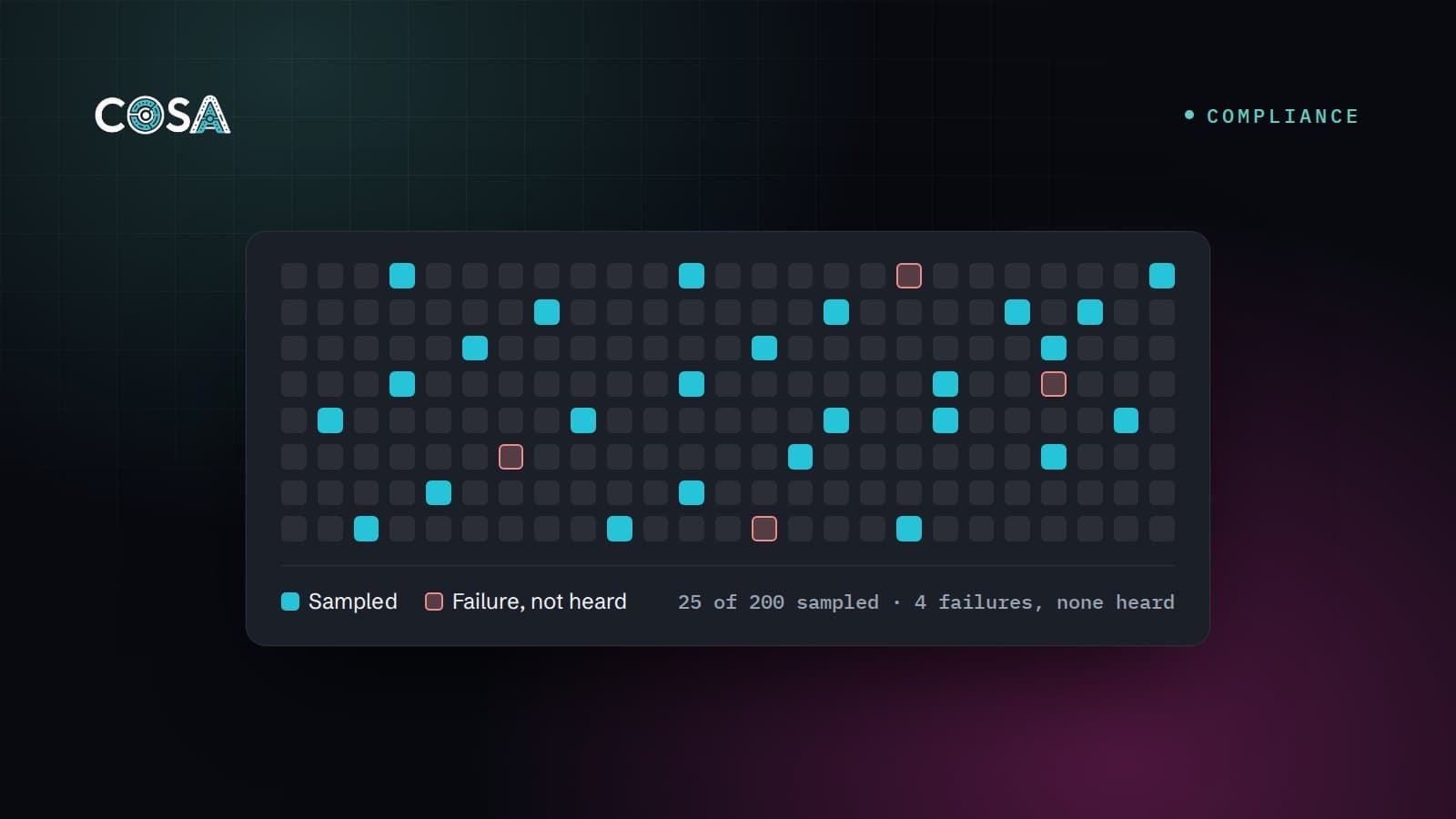
Keep an audit trail from each issue to its action and result, and see compliance MI your board will read and Consumer Duty board reports for presentation. A manual scorecard only covers a sample: the maths of call QA sampling and the sample size calculator show what a sample can miss.
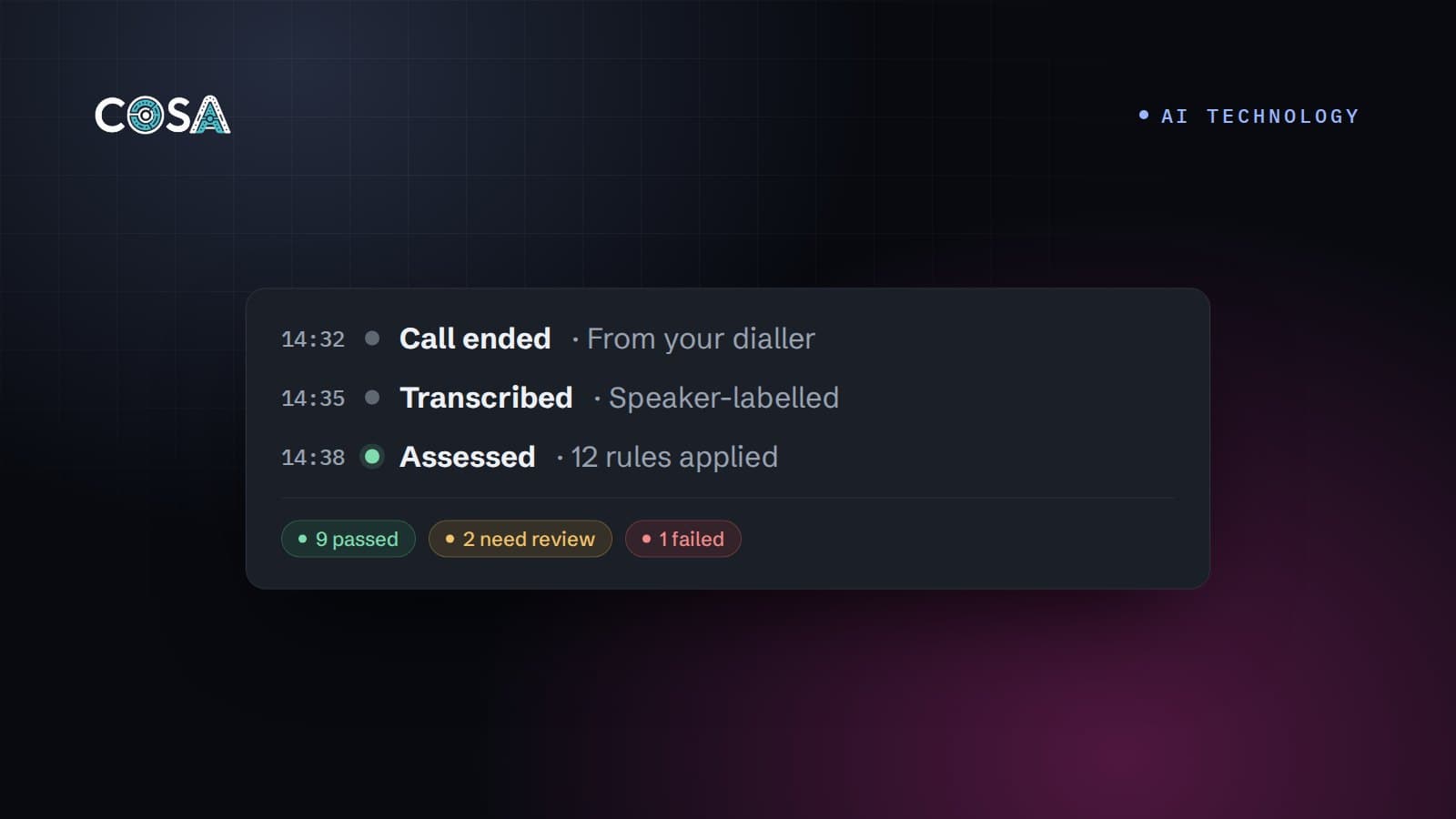
COSA can check scorecard items like these on every in-scope call. Items can become rules of the matching type, such as verbatim, non-verbatim or vulnerability detection, scoped to the call types you choose. Every verdict (Passed, Needs review or Failed) carries a written explanation, quoted evidence and a confidence level, and reviewer overrides keep the original verdict for audit. The outcome verdict and calibration stay with your reviewers: COSA supports, and does not replace, professional compliance review. See how rules work.
This article is general information, not legal or regulatory advice. Adapt the scorecard to your firm's policies, products and the rules that apply to your business.