Consumer Duty outcomes monitoring is how a firm checks, regularly and with evidence, whether retail customers actually get good outcomes from its products, communications and customer support, works out why when they don't, and acts on it. The rules are in PRIN 2A.9. The FCA's July 2026 review sets out what good practice looks like: clear definitions, explained tolerances, root cause and action.
What is Consumer Duty outcomes monitoring?
Outcomes monitoring is the part of the Consumer Duty that turns good intentions into evidence. Under PRIN 2A.9, a firm must regularly monitor the outcomes retail customers receive from three things:
- the products it manufactures or distributes;
- the communications it has with retail customers;
- the customer support it provides.
That monitoring must let the firm determine, at least, whether customers are sold products designed to meet their needs, whether those products provide fair value, whether customers are equipped with the right information to make effective, timely and properly informed decisions, and whether they receive the support they need. Those are the four outcomes, restated as questions the firm's own data has to answer.
A firm must also be able to identify whether any group of retail customers is experiencing different outcomes from another group of customers of the same product, have processes to identify the root causes of any failure to deliver the outcomes, and take appropriate action where customers are not receiving them, are at risk of not receiving them, or where one group is worse off.
In its July 2026 review, the FCA summed up the standard: collecting data, listing metrics or reporting MI does not, by itself, show whether customers are receiving good outcomes. A firm should be able to explain what its information tells it, how it uses it to identify risks or issues, what action it takes, and whether that action improved outcomes.
What did the FCA's July 2026 outcomes monitoring review find?
On 27 July 2026 the FCA published Outcomes monitoring: good practice and areas for improvement. It covers three areas: strategy and framework; data, MI and testing; and governance, oversight and culture. It describes what the FCA saw in firms; it does not set new rules. The table below draws on the review and on the FCA's companion blog on outcomes monitoring.
| What good looked like | Where firms fell short |
|---|---|
| A smaller firm translated the four outcomes into clear expectations at key stages of the customer journey, and linked them to MI and thresholds, including measures of customer behaviour, service performance and feedback. | Many firms set specific thresholds but did not clearly explain how they indicated good or poor outcomes. |
| That firm based its thresholds on historical performance, available benchmarks and senior management judgement. | Some firms relied on reactive or poorly defined indicators (from the blog). |
| One firm used its past performance to set targets, then reviewed and challenged them through governance to make sure they were not too easy to meet. | Some firms lacked clear audit trails and could not show how data was used to identify emerging risks (from the blog). |
The blog also addresses proportionality: firms do not need complex systems or large teams to monitor outcomes effectively, provided the approach is clear, risk-based and linked to action. Complaints alone are not enough. In its separate products and services good practice material, the FCA described a smaller firm that relied almost entirely on complaint volumes as an indicator of customer outcomes, which risked limited visibility of issues that led to poor outcomes but not to complaints.
Lessons from the FCA's insurance outcomes monitoring review
In December 2023 the FCA requested the most recent board and committee reporting from 20 larger insurance firms, including general insurers, life insurers, intermediaries and regulated third-party outsourcers that service insurers. It published its insurance multi-firm review on 26 June 2024. Its findings are not obligations on advice firms, but several translate directly:
- Process is not outcome. Some firms relied on metrics confirming the number or percentage of product reviews, value assessments or other processes completed. Those show work was done, not what customers experienced.
- Tolerances that never trip. The FCA flagged "tolerances set at a level that the firm was unlikely to breach and therefore may permanently report as Green", and combined red-amber-green ratings that kept reporting green despite a negative trend, or underlying data that should have pointed to potentially poor outcomes.
- Borrowed thresholds. "Thresholds which are set by using industry averages without justification."
- Monitoring without action. Few firms could give clear evidence of monitoring that had directly led to proactive action to improve outcomes.
On the good practice side, some firms had clearly articulated tolerances for all key metrics, with formal governance to set them at an appropriate level and scrutinise them annually. Where second-line teams scrutinised monitoring, they challenged the type and granularity of the data, its interpretation and the thresholds applied, especially where reporting focused on red-amber-green ratings.
Among the metrics the review gives as good practice are complaints data with root cause analysis, and "file reviews, quality assurance and/or call monitoring". It also criticised complaints data that showed only the number of complaints, with no root cause analysis. The second of those metrics is where an advice firm's call QA fits.
How do you build an outcomes monitoring framework?
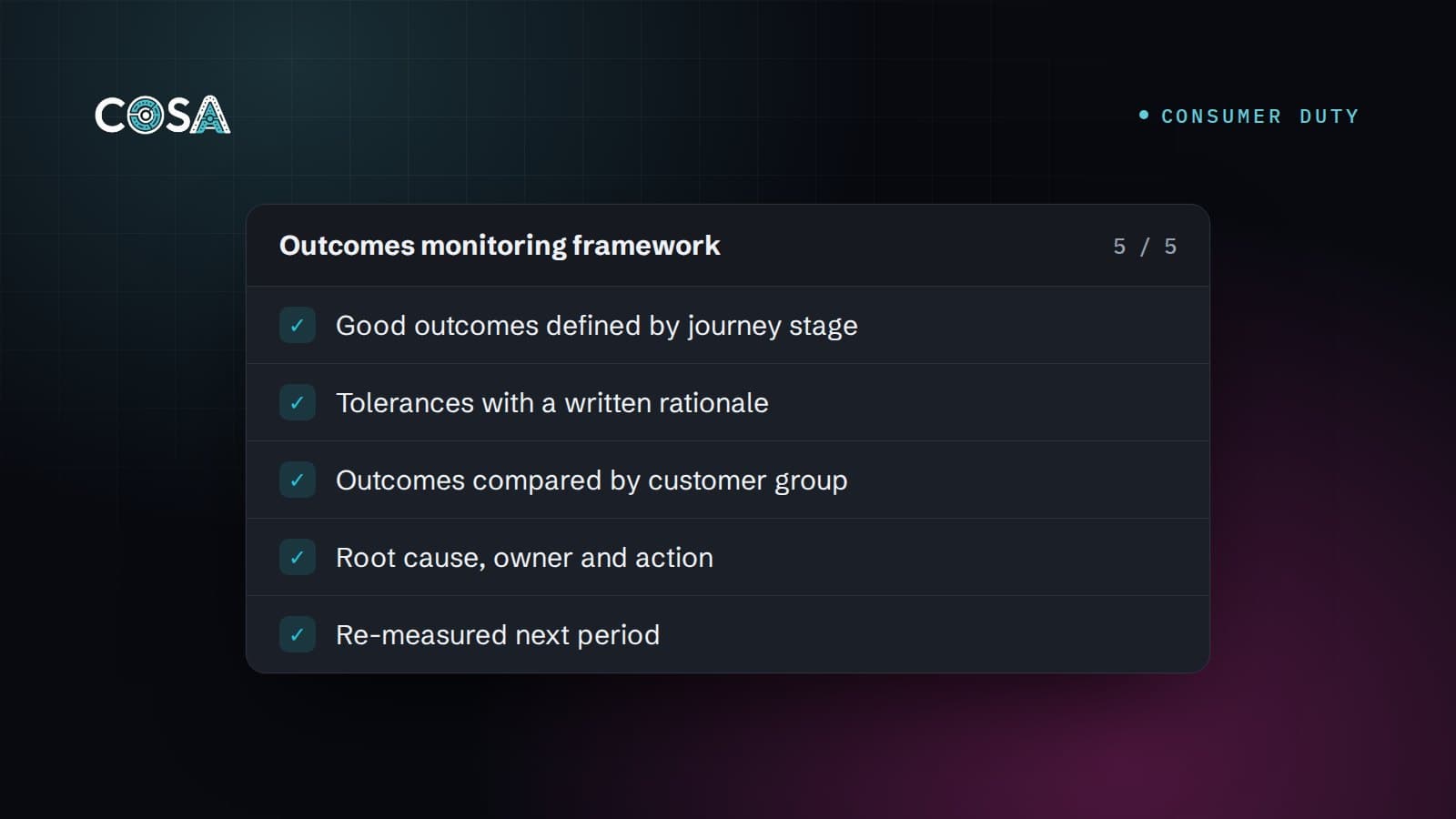
The FCA's findings point to four building blocks. None needs a large team, but each needs to be written down.
- Define good and poor outcomes. For each outcome and each journey stage (for example fact find, recommendation and follow-up), write down what good and poor look like. "The customer understood how interest rolls up and what it means for their estate" is a definition. "Consumer understanding: green" is not.
- Choose a few indicators for each definition. Mix measures you can see in the conversation, such as needs explored, costs explained, understanding checked and vulnerability handled, with later signals such as complaints, cancellations and withdrawn cases. Complaints alone miss harm that never becomes a complaint.
- Set a tolerance for each indicator, and record why. Use a baseline from past performance, a benchmark you can justify or a documented management judgement, the same three sources as the smaller-firm example in the FCA's review. Challenge any tolerance that has never been breached.
- Compare customer groups. Look at the same indicators for customers with characteristics of vulnerability against everyone else, and by adviser where volumes are large enough to be fair.
The table below is an illustrative example for a telephone-based advice firm. Its figures are not FCA thresholds or industry benchmarks.
| Outcome | Call indicator | Example tolerance and rationale | A breach triggers |
|---|---|---|---|
| Products & services | Alternatives discussed on fact finds | At least 97%: just below last year's monthly average of 98%, so a real dip trips it | Review failing calls by adviser and script |
| Price & value | Fees and long-term costs explained where relevant | At least 95%: committee judgement for key cost information | Pull the calls; brief advisers |
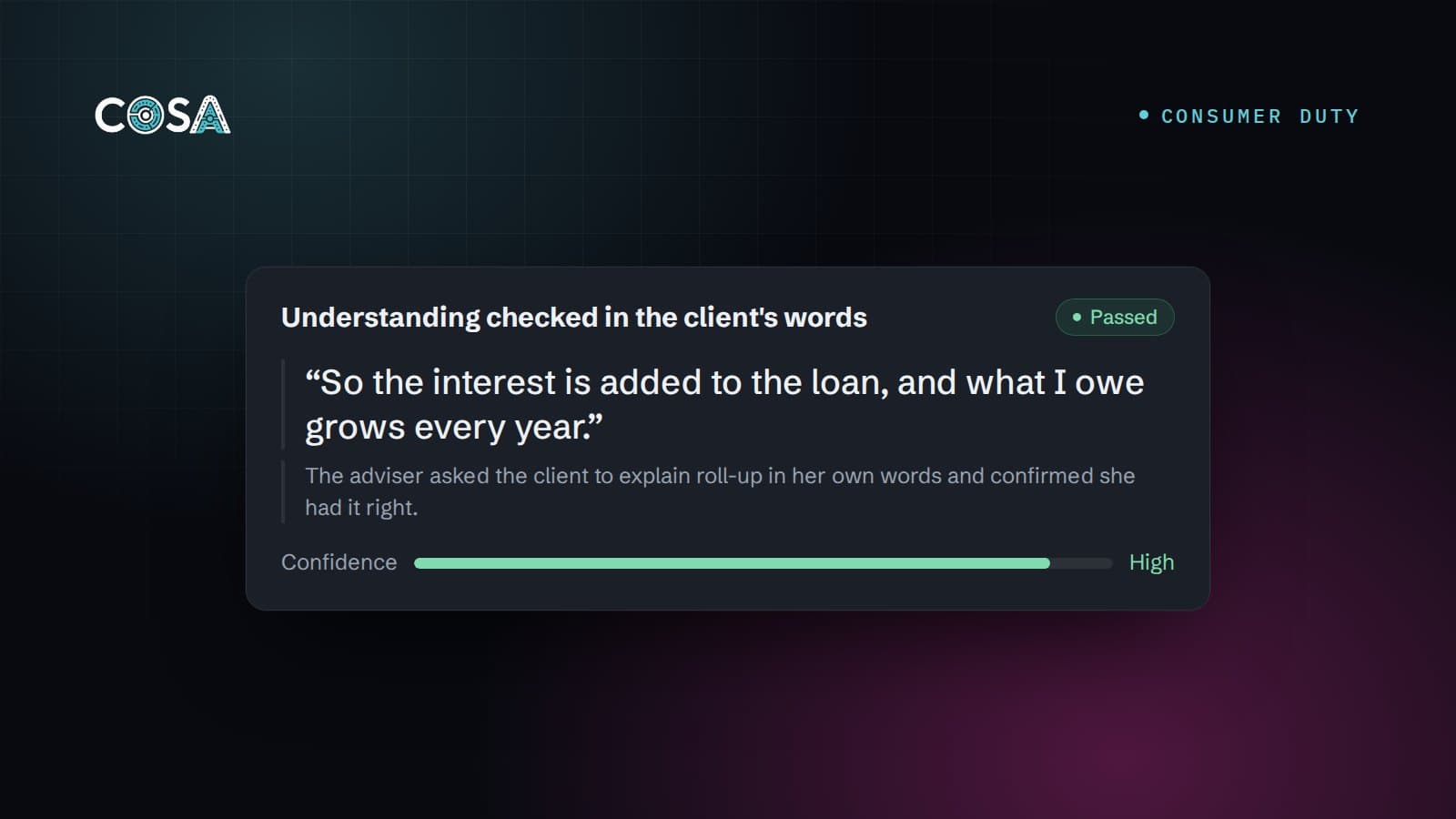
| Consumer understanding | Understanding checked in the customer's own words (teach-back) | At least 85%: two-quarter baseline of 88%, less normal variation | Review the script; coach on teach-back |
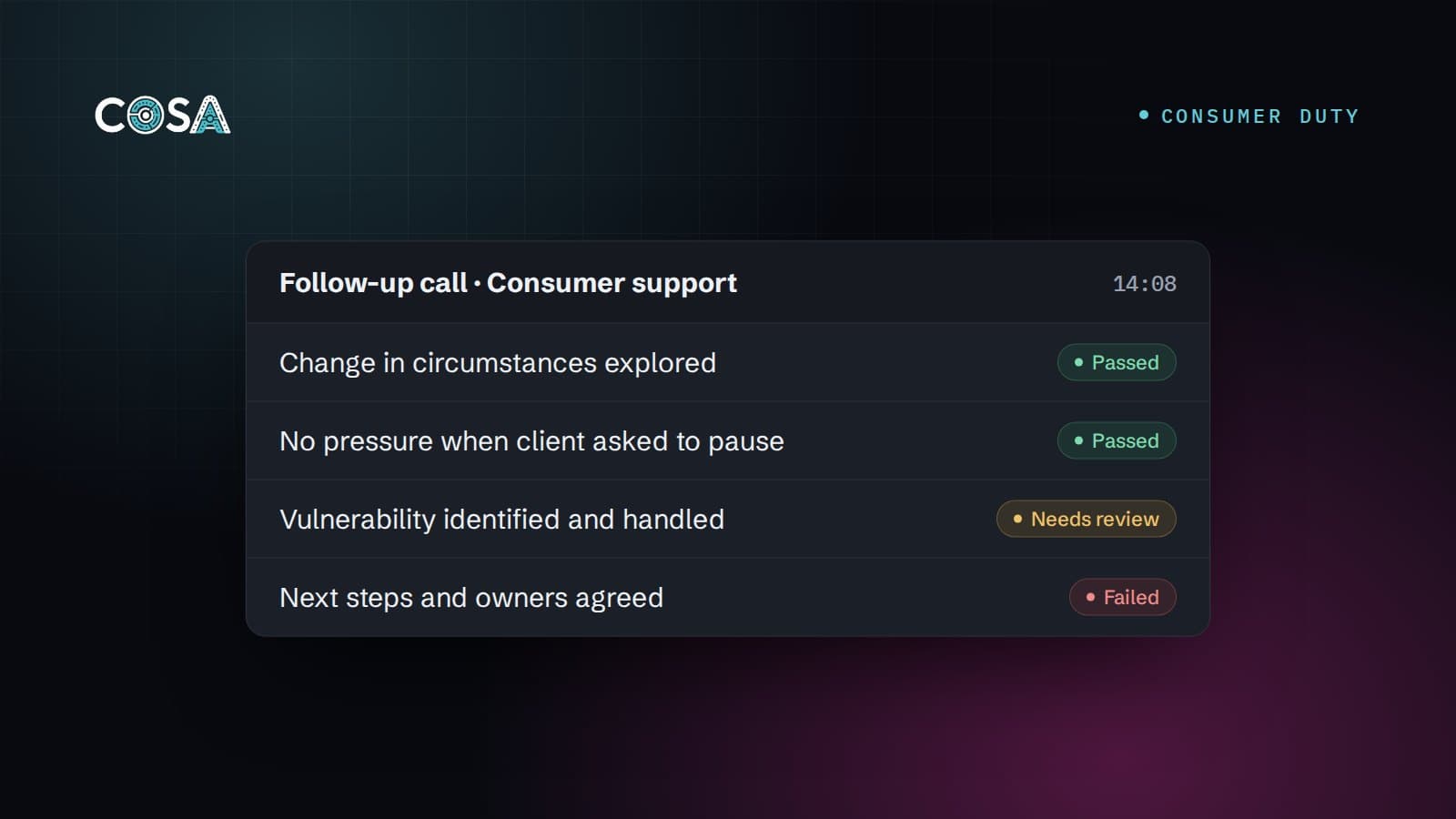
| Consumer support | Vulnerability signals identified and handled | Every call with a signal reviewed by a person | Case review; contact the customer where needed |
| Customer groups | Same indicators: vulnerability signals against everyone else | Gap of no more than 5 points | Root cause review of the gap |
Calls are stronger evidence for some outcomes than others. Products and services and price and value rest mainly on product governance and fair value work, where call indicators complement other data rather than replace it. To turn definitions into checks a reviewer, or software, can apply consistently, see writing compliance rules an AI can check and our call QA scorecard template.
Root cause, action, and showing it worked
PRIN 2A.9 requires processes to identify root causes, and appropriate action where outcomes fall short. The FCA's outcomes monitoring blog describes the strongest firms as able to identify an issue, understand its cause, act on it, and then assess whether that action improved outcomes for customers. In the insurance review, few firms could show that monitoring had directly led to proactive action, so the last two steps deserve the most attention.
- Breach. An indicator moves outside its tolerance, or a trend heads the wrong way while the headline rating still looks fine.
- Pull the cases. Look at the calls or files behind the number.
- Classify the cause. Script, training, process, product or an individual adviser. A failure spread across every adviser usually points to a script or process; one concentrated in a few points to coaching.
- Fix it, with an owner and a date. Scripts are communications too, and the FCA's Year 2 board reports blog says firms should be able to evidence how they test communications and assess consumer comprehension.
- Re-measure the same indicator next period, and record whether the action worked.
Keep definitions stable so before-and-after comparisons mean something; if a rule has to change, re-baseline it and say so in the MI. A simple action tracker can do the job: for each issue, record the root cause, owner, action and date, escalation route and the result on re-measurement. Complaints need the same discipline: see complaints root cause analysis.
How can call recordings be used to evidence Consumer Duty outcomes?
For a telephone-based advice firm, the call is where much of the communication and support happens. That makes it direct evidence for the consumer understanding and consumer support outcomes. The FCA's Year 2 board reports blog found some reports focused more on products and value than on those two.
The FCA's consumer support good practice page, updated on 10 July 2026, gives two examples. Some firms used proactive tools, such as speech analytics in call centres, to assess the quality of support and identify risks of poor outcomes. Smaller firms without such tools "may consider proportionate methods", which "could include periodic call listening or file reviews using a simple checklist". The same page criticises monitoring that relies only on transactional metrics, such as contact rates and wait times, or only on complaints and feedback. Both examples are good practice, not requirements, and no rule sets a call coverage figure.
Four things decide what a call-based indicator is worth:
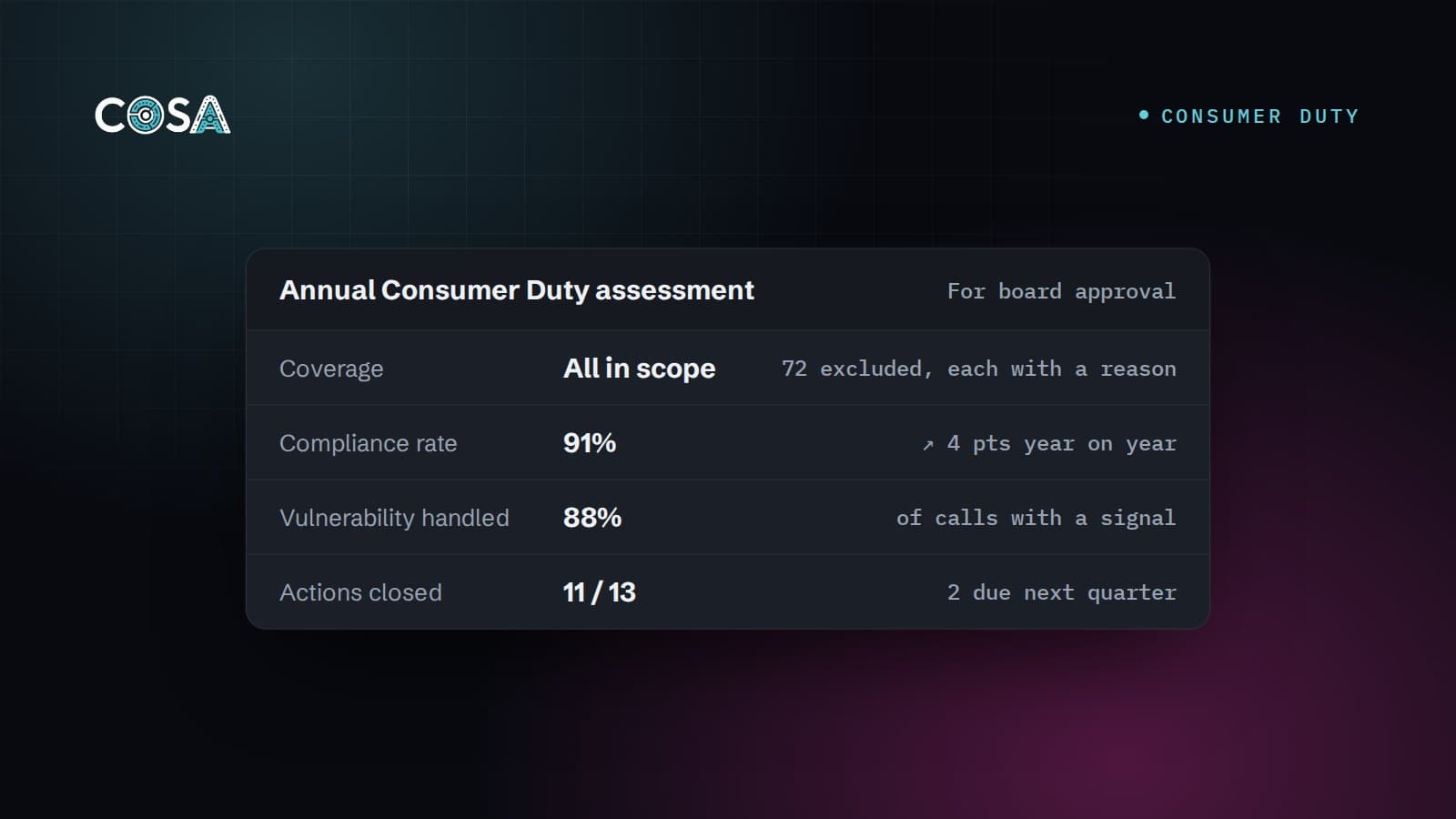
- Coverage. A compliance rate from a sample describes the sample. A written call-selection policy, with every exclusion logged and a reason given, makes clear which calls the indicator covers. The maths of call QA sampling and the sample size calculator show how much a sample can miss.
- Quoted evidence. A breach backed by what was said, on which call and by whom can be investigated straight away.
- Reviewer overrides. If reviewers keep overriding results on one rule, the definition or rule probably needs rewording, which takes you back to the first step of the framework.
- Vulnerability signals. When calls carry a flag for characteristics of vulnerability, the same indicators can be compared for those customers against everyone else.
Governance: from MI to board challenge
In its outcomes monitoring blog the FCA said: "We still want to see clearer evidence of challenge, discussion and decision-making." Its Year 2 board reports blog made a similar point: some firms presented a lot of data without explaining what it showed about customer outcomes.
Under the current PRIN 2A.8 governance rules, a firm must prepare a report for its governing body setting out the results of its PRIN 2A.9 monitoring and any actions required, and the governing body must review and approve it at least annually. Reviewing the first Consumer Duty board reports from 180 firms, the FCA said the assessment should include monitoring results on whether products and services deliver the expected outcomes, and any evidence of poor outcomes, including whether any group of customers receives worse outcomes than another. For smaller firms, it said an absence of complaints should not be relied on as the only evidence that outcomes are being met.
In practice: minute the questions asked and decisions taken, not just that a report was noted; show each breach alongside the action it triggered; and make the annual report a summary of the year's monitoring. Our guides to what to put in a Consumer Duty board report, compliance MI your board will read and showing reasonable steps under SM&CR cover the reporting and accountability side.
An outcomes monitoring checklist for advice firms
- Good and poor outcomes defined for each outcome and journey stage.
- Indicators drawn from conversations, not only complaints and process completion.
- Every tolerance has a written rationale and a review date; tolerances that never breach are challenged.
- Outcomes compared by customer group, including vulnerability.
- Call coverage stated, with exclusions logged and reasons given.
- Every breach has a root cause, owner, action and re-measurement.
- Board challenge and decisions minuted, not just noted.
COSA can supply the call side of this evidence. A call-selection policy decides which finished calls are assessed and logs every excluded call with its reason. Each in-scope call is assessed against the firm's own rules, with a written explanation, quoted evidence and a confidence level behind every verdict; reviewer overrides keep the original verdict for audit; and the MI dashboards show compliance rate, outcomes by call type and by adviser, and the most-failed rules. Setting tolerances, finding causes and deciding what to do stay with the firm: COSA supports, and does not replace, professional compliance review. See how COSA supports the Consumer Duty or explore the MI.
This article is general information, not legal or regulatory advice. Refer to PRIN 2A and FG22/5 for the requirements that apply to your firm.